
Maximize $Z = x + 2y$ subject to the constraints $x-y≥0, 2y ≤ x + 2, x ≥0, y ≥0$.
Answer & explanation
Correct answer: option 2
The correct answer is Option (2) → $Z=6$ at $(2,2)$
We draw the lines $x - y = 0, 2y = x + 2$ and shaded the feasible region. We note that the feasible region is unbounded. Corner points are O(0, 0) and A(2, 2). At corner points, the values of Z are
|
Corner point |
$Z = x + 2y$ |
|
(0, 0) |
0 → smallest |
|
(2, 2) |
6 → largest |
Here, we are to determine the maximum value.
As the feasible region is unbounded, we cannot say whether the largest value 6 is maximum or not.
To check whether largest value 6 is maximum:
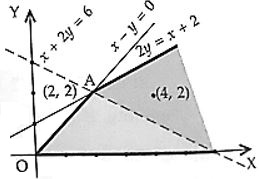
We draw the half plane $x+2y>6$ and notice it has common points with feasible region. Hence, there is no maximum value of Z. Notice that the point (4, 2) which lies in the feasible region yields $Z=8$ etc. In fact, all points in the dark shaded region yield values which are greater than 6.