
Read the passage given and answer the question.
Phenol and alcohol have the same functional group (-OH) but phenols are stronger acids than alcohols due to the resonance stabilization of phenoxide ion than alkoxide ion \((-RO^-)\). Electron withdrawing groups tend to increase the acidic strength while electron releasing groups tend to decrease it.
The most acidic compound is
Answer & explanation
Correct answer: option 3
The correct answer is Option (3) → p-Nitrophenol
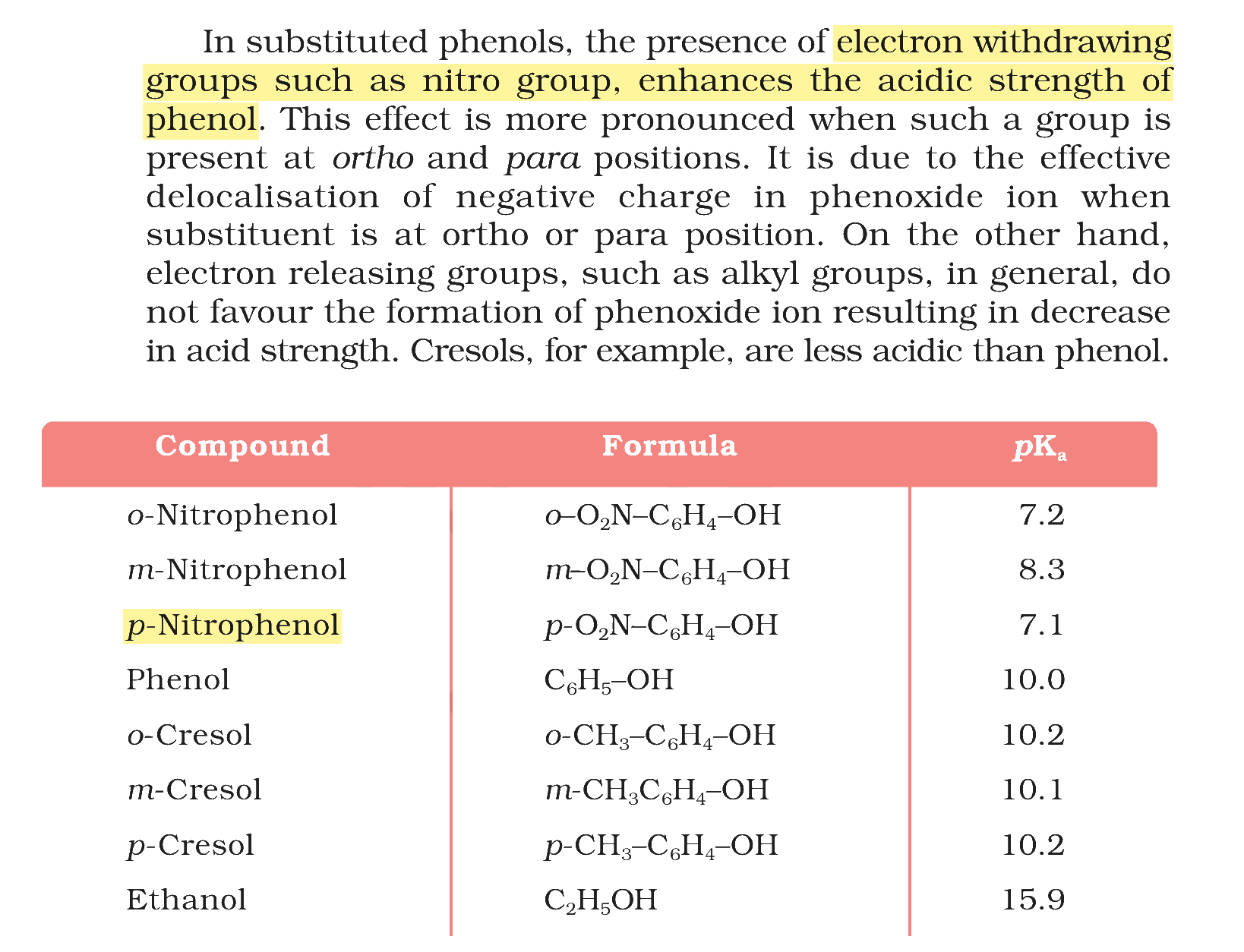
Phenols are acidic because the phenoxide ion is stabilised by delocalising its negative charge into the benzene ring. An electron-withdrawing group such as –\( \ce{NO2} \) spreads the charge further and increases the acidity, most strongly at the ortho and para positions, where the charge can reach the nitro group by resonance. Electron-releasing groups (alkyl) decrease the acidity, and alcohols are much weaker acids than phenols because the alkoxide charge is not delocalised.
pKa values (lower pKa = stronger acid): p-nitrophenol 7.1 < phenol 10.0 < p-cresol 10.2 < benzyl alcohol (about 15). So p-nitrophenol is the most acidic.
Why the other options are incorrect
Option (1) Benzyl alcohol — Incorrect. \( \ce{C6H5CH2OH} \) is an alcohol; the –OH is on a \( \ce{CH2} \) group, not on the ring, so its anion is not stabilised by the ring and it is the weakest acid of the four.
Option (2) Phenol — Incorrect. Acidic because of resonance in the phenoxide ion, but it has no electron-withdrawing group (pKa 10.0).
Option (4) p-cresol — Incorrect. The \( \ce{CH3} \) group releases electrons and destabilises the phenoxide ion, so p-cresol (pKa 10.2) is even less acidic than phenol.
NCERT (2026-27 edition):
Acidity of Phenols – …
Note: The same/similar question has been asked in different years by NTA as per the details given below:
| 2026 | 2025 | 2024 | 2023 | 2022 |
|---|---|---|---|---|
| – | – | – | 07-06 S3 30-05 S1 | – |