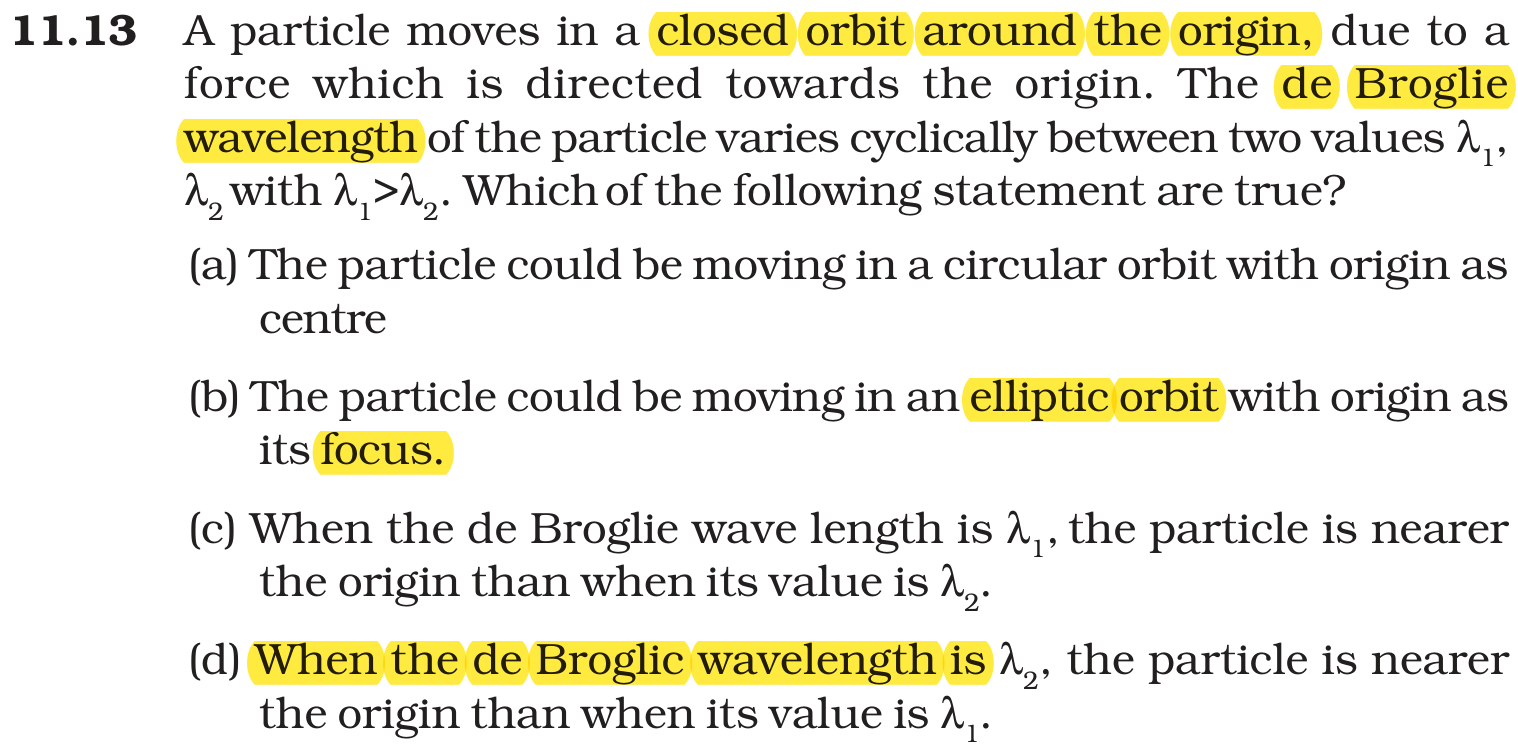
A particle moves in a closed orbit around the origin, due to a force which is directed towards the origin. The de-Broglie wavelength of particle varies cyclically between two values \( (\lambda_1), (\lambda_2) \) with \( (\lambda_1 \gt \lambda_2) \) then, the correct statement from the following are:
(a) The particle could be moving in a circular orbit with origin as centre
(b) The particle could be moving in an elliptical orbit with origin as its focus.
(c) When the de-Broglie wave length is \( \lambda_1 \), the particle is nearer to origin than when its value is \( \lambda_2 \).
(d) When the de Broglie wavelength is \( \lambda_2 \), the particle is nearer to the origin than when its value is \( \lambda_1 \).
Answer & explanation
Correct answer: option 2
The correct answer is Option (2) → (b) and (d) only
The de Broglie wavelength is \( \lambda = h/(mv) \), so a changing wavelength means a changing speed, and a larger wavelength means a smaller speed.
\( \displaystyle \lambda_1 \gt \lambda_2 \;\Rightarrow\; v_1 \lt v_2 \)
The force always points to the origin (a central force), so its torque about the origin is zero and the angular momentum \( L = m v r_{\perp} \) is conserved. The particle therefore moves faster when it is nearer the origin.
(a) The particle could be moving in a circular orbit with origin as centre — Incorrect. In a circular orbit about the centre of force the speed is constant, so \( \lambda \) could not vary.
(b) The particle could be moving in an elliptical orbit with origin as its focus. — Correct. In an elliptical orbit about a centre of force at the focus (like a planet round the Sun) the distance and the speed both vary cyclically, so \( \lambda \) varies between two values.
(c) When the de-Broglie wave length is \( \lambda_1 \), the particle is nearer to origin than when its value is \( \lambda_2 \). — Incorrect. \( \lambda_1 \) is the larger wavelength, so the speed is the smaller one, which occurs at the farthest point.
(d) When the de Broglie wavelength is \( \lambda_2 \), the particle is nearer to the origin than when its value is \( \lambda_1 \). — Correct. \( \lambda_2 \) is the smaller wavelength, so the speed is the larger one, and by conservation of angular momentum the speed is largest nearest the origin.
NCERT Exemplar:
Dual Nature of Radiation and Matter – …