Which state of India was reorganised on linguistic basis?
Answer & explanation
Correct answer: option 2
The correct answer is Option (2) → Andhra Pradesh
Note 1: The given answer is as per the official NTA Answer Key. However, the question can have more than one correct answer, i.e. Options (1), (2), (3) and (4), as explained below. Option (2) is taken as the best answer because Andhra was the first State formed on a linguistic basis.
Option (1) Karnataka — Also true. The Mysore State, renamed Karnataka in 1973, took its shape in the reorganisation of 1956, which drew the boundaries of the states to reflect the boundaries of languages.
Option (2) Andhra Pradesh — Correct. The Vishalandhra movement demanded that the Telugu-speaking areas be separated from the Madras province. After Potti Sriramulu died on his fast, the Prime Minister announced a separate Andhra state in December 1952. Its formation spurred the struggle for other states on linguistic lines.
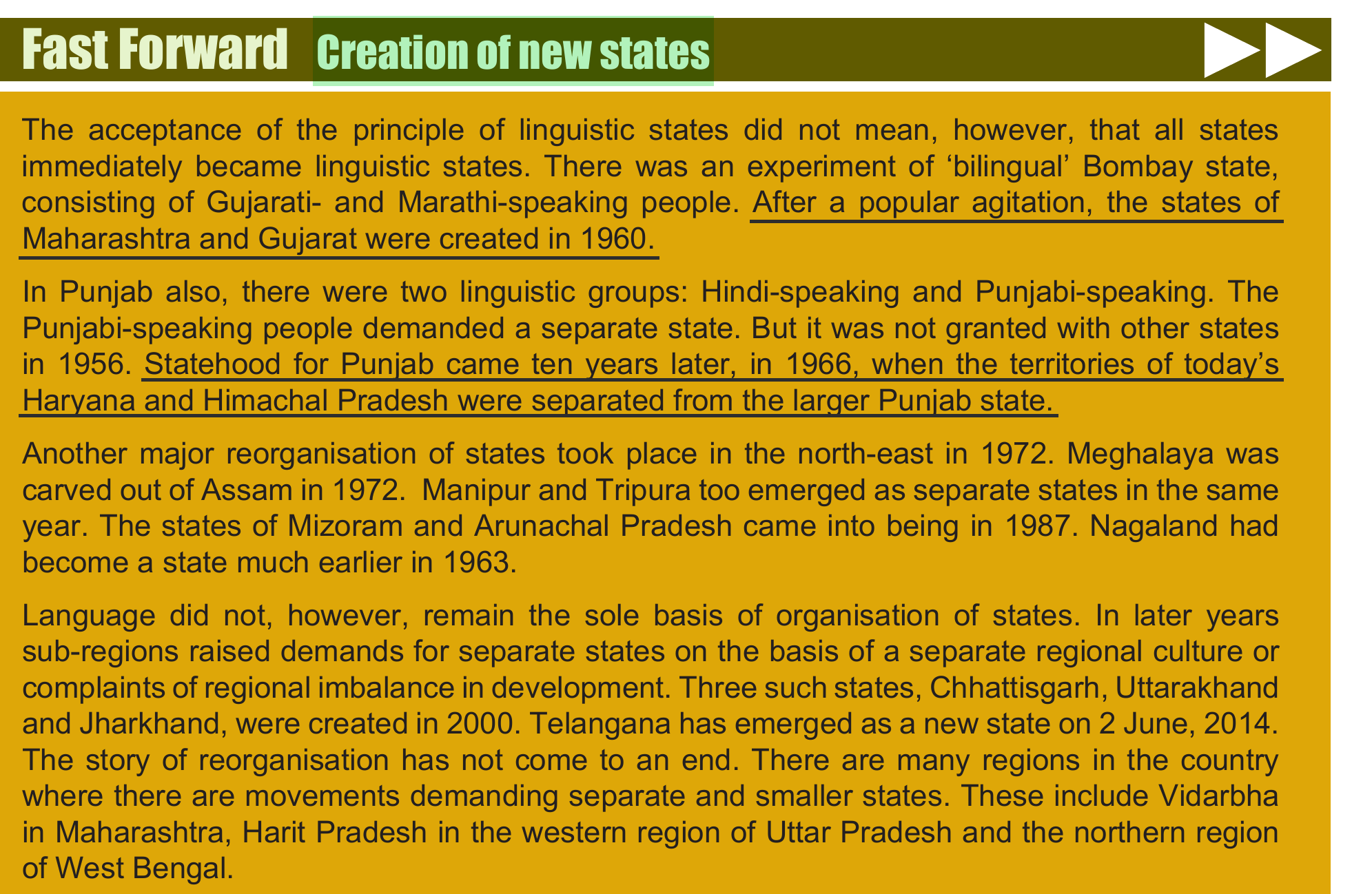
Option (3) Haryana — Also true. Punjab had two linguistic groups, Hindi-speaking and Punjabi-speaking; in 1966 the territories of today’s Haryana and Himachal Pradesh were separated from Punjab.
Option (4) Gujarat — Also true. The bilingual Bombay state had Gujarati- and Marathi-speaking people; after a popular agitation, Maharashtra and Gujarat were created in 1960.
Hence, the answer is Option (2).
Note 2: None of the NCERT books — the pre-rationalised, 2023-24, 2025-26 or 2026-27 edition — describes the reorganisation of the Mysore State (Karnataka); they say only that the States Reorganisation Act of 1956 created 14 states and six union territories on the basis of language.
Note 3: A same/similar question was asked in CUET (UG) in the papers below.
| 2026 | 2025 | 2024 | 2023 | 2022 |
| – | – | – | 30-05 S2 02-06 S3* | – |
* A similar question.
NCERT (2026-27): Politics in India since Independence — Chapter 1: Challenges of Nation Building
NCERT (2026-27): “Reorganisation of States … The movement gathered momentum as a result of the Central government’s vacillation. Potti Sriramulu, a Congress leader and a veteran Gandhian, went on an indefinite fast that led to his death after 56 days. This caused great unrest and resulted in violent outbursts in Andhra region. People in large numbers took to the streets. Many were injured or lost their lives in police firing. In Madras, several legislators resigned their seats in protest. Finally, the Prime Minister announced the formation of a separate Andhra state in December 1952. Reorganisation of States … The formation of Andhra spurred the struggle for making of other states on linguistic lines in other parts of the country. These struggles forced the Central Government into appointing a States Reorganisation Commission in 1953 to look into the question of redrawing of the boundaries of states. The Commission in its report accepted that the boundaries of the state should reflect the boundaries of different languages. On the basis of its report the States Reorganisation Act was passed in 1956. This led to the creation of 14 states and six union territories.” |