


CUET Preparation Today
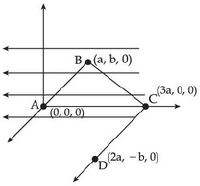
A point charge q moves from point A to point D along the path ABCD (as shown) in a uniform electric field E pointing parallel to negative direction of X-axis. The co-ordinates of A, B, C, D are (0, 0, 0), (a, b, 0), (3a, 0, 0) and (2a, -b, 0) respectively. The work done by the field in the above process is given by expression:
|
$qEa$ $\sqrt{2}qEa$ $-qEa$ $-2aqE$ |
$-2aqE$ |
The correct answer is Option (4) → $-2aqE$ To calculate the work done by a uniform electric field $(\vec E)$, when a point charge move along a given path, $W=q\int\vec E.d\vec r$ $A(0,0,0)$ $B(a,b,0)$ $C(3a,0,0)$ $D(2a,-b,0)$ $W_{A→B}=q\vec E.d\vec r_{AB}$ $=q(-E\hat i).(a\hat i+b\hat j)$ $=-qEa$ $W_{B→C}=q(-E\hat i).(2a\hat i-b\hat j)$ $=-2qEa$ $W_{C→D}=q(-E\hat i).(-a\hat i-b\hat j)$ $=qEa$ $W=W_{AB}+W_{BC}+W_{CD}$ $=-2qEa$ |