
Answer the questions on the basis of passage given below:
As aldehydes & ketones possess the carbonyl functional group, they show similar reactions. They exhibit nucleophilic addition reactions, reduction, oxidations, reactions due to α-hydrogen atom, and many other reactions, like Cannizzaro reaction to electrophilic substitution reactions (in case of aromatic aldehydes & ketones). These reactions help in the preparation of a number of important compounds, like acetic acid, vinyl acetate, polymers and in perfume and dye industries. Nucleophilic addition reactions form cyanohydrins, acetals, alcohols and N-substituted derivatives like imine, oxime, semicarbazone, phenylhydrazone & Schiff’s base. Reactions due to α-hydrogen atoms help in formation of aldols and α,β-unsaturated aldehydes & ketones.
Out of the following compounds, which will give iodoform test
(A) Isopropyl alcohol
(B) Isobutyl alcohol
(C) Secondary butyl alcohol
(D) Ethyl alcohol
(E) Acetic acid
Choose the correct answer from the options given below:
Answer & explanation
Correct answer: option 2
The correct answer is Option (2) → A, C, D
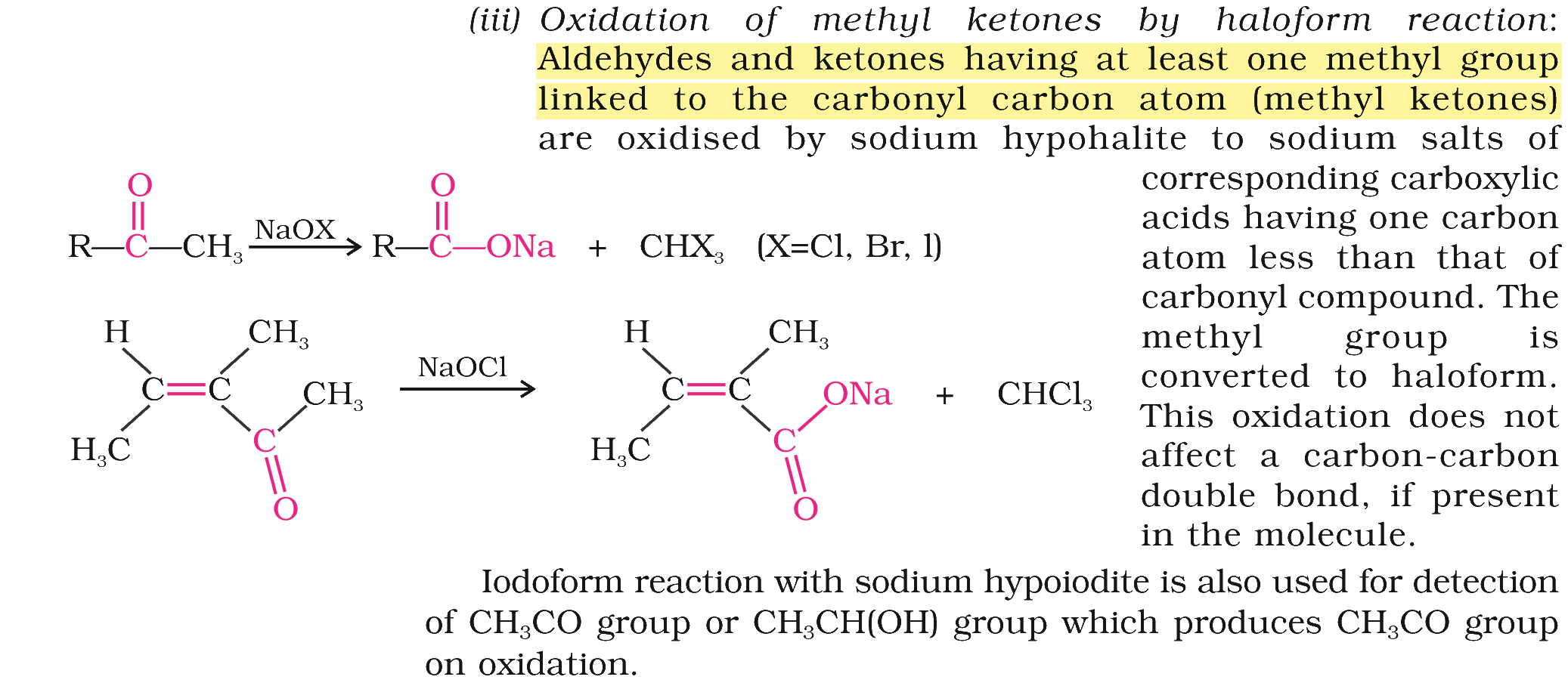
The iodoform test (NaOH + \( \ce{I2} \), i.e. sodium hypoiodite) gives a yellow precipitate of \( \ce{CHI3} \) with compounds that have a CH3CO– group (methyl ketones and ethanal), and with alcohols that have a CH3CH(OH)– group, because hypoiodite first oxidises such an alcohol to a \( \ce{CH3CO} \)– compound. Ethanoic acid does not respond: its \( \ce{CH3CO} \)– group is part of a carboxyl group.
(A) Isopropyl alcohol — Correct. \( \ce{CH3CH(OH)CH3} \) has the \( \ce{CH3CH(OH)} \)– group; it is oxidised to propanone, which gives iodoform.
\( \ce{CH3CH(OH)CH3 + 4I2 + 6NaOH -> CHI3 v + CH3COONa + 5NaI + 5H2O} \)
(B) Isobutyl alcohol — Incorrect. \( \ce{(CH3)2CHCH2OH} \) has –OH on a \( \ce{CH2} \) group with no \( \ce{CH3} \) on the same carbon.
(C) Secondary butyl alcohol — Correct. \( \ce{CH3CH(OH)CH2CH3} \) has the \( \ce{CH3CH(OH)} \)– group; it is oxidised to butan-2-one, which gives iodoform.
\( \ce{CH3CH(OH)CH2CH3 + 4I2 + 6NaOH -> CHI3 v + CH3CH2COONa + 5NaI + 5H2O} \)
(D) Ethyl alcohol — Correct. \( \ce{CH3CH2OH} \) (\( \ce{CH3CH(OH)} \)– with H) is oxidised to ethanal, \( \ce{CH3CHO} \), which gives iodoform.
\( \ce{CH3CH2OH + 4I2 + 6NaOH -> CHI3 v + HCOONa + 5NaI + 5H2O} \)
(E) Acetic Acid — Incorrect. In \( \ce{CH3COOH} \) the C=O is part of the –COOH group; the acid does not give the test.
NCERT (2026-27 edition):
Oxidation of Methyl Ketones by Haloform Reaction
Note: The same/similar question has been asked in different years by NTA as per the details given below:
| 2026 | 2025 | 2024 | 2023 | 2022 |
|---|---|---|---|---|
| – | – | – | 12-06 S2 25-05 S3 | – |