
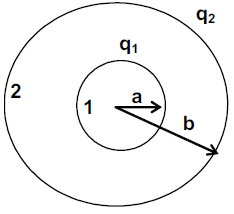
Two concentric conducting spherical shells of radii a and b (a < b) carry charges \( q_1 \) and \( q_2 \) respectively, as shown. What is the potential difference between the inner shell and the outer shell?
Answer & explanation
Correct answer: option 3
The correct answer is Option (3) → \( \displaystyle\frac{q_1}{4\pi\varepsilon_0}\left(\frac{1}{a}-\frac{1}{b}\right) \)
A charged spherical shell of radius R and charge q gives the potential \( q/4\pi\varepsilon_0r \) outside it, as if the charge sat at the centre. Inside it, the potential has the constant value \( q/4\pi\varepsilon_0R \) everywhere. The potential of each shell is the sum of the potentials due to both charges.
From the figure, the inner shell (radius a) lies inside the outer shell (radius b). The potential of the inner shell is:
\( \displaystyle V_a=\frac{q_1}{4\pi\varepsilon_0a}+\frac{q_2}{4\pi\varepsilon_0b} \)
The outer shell is outside the inner one, so its potential is:
\( \displaystyle V_b=\frac{q_1}{4\pi\varepsilon_0b}+\frac{q_2}{4\pi\varepsilon_0b} \)
The potential difference is:
\( \begin{aligned} V_a-V_b &= \frac{q_1}{4\pi\varepsilon_0a}-\frac{q_1}{4\pi\varepsilon_0b} \\ &= \frac{q_1}{4\pi\varepsilon_0}\left(\frac{1}{a}-\frac{1}{b}\right) \end{aligned} \)
Hence, the potential difference does not depend on the charge \( q_2 \) on the outer shell. The charge \( q_2 \) gives the same potential \( q_2/4\pi\varepsilon_0b \) at both shells. Only the inner charge \( q_1 \) gives them different potentials.
NCERT (2026-27):
Potential Due to a System of Charges – “We have seen in Chapter 1 that for a uniformly charged spherical shell, the electric field outside the shell is as if the entire charge is concentrated at the centre. Thus, the potential outside the shell is given by
\( \displaystyle V=\frac{1}{4\pi\varepsilon_0}\,\frac{q}{r}\quad(r\ge R) \)\( \qquad [2.19(a)] \)
where q is the total charge on the shell and R its radius. The electric field inside the shell is zero. This implies (Section 2.6) that potential is constant inside the shell (as no work is done in moving a charge inside the shell), and, therefore, equals its value at the surface, which is
\( \displaystyle V=\frac{1}{4\pi\varepsilon_0}\,\frac{q}{R} \qquad [2.19(b)] \)”