
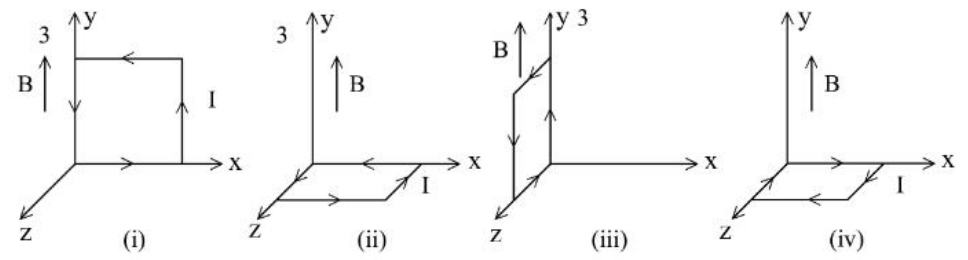
A uniform magnetic field is established along the +y direction. A square loop carrying current is placed in the magnetic field as shown in the figures. Which case corresponds to stable equilibrium?
Answer & explanation
Correct answer: option 3
The correct answer is Option (3) → (ii)
A current loop in a uniform field behaves as a magnetic dipole of moment \( \vec{m} = I\vec{A} \), with \( \vec{A} \) given by the right-hand rule on the sense of the current. It feels the torque \( \vec{\tau} = \vec{m}\times\vec{B} \) and has energy \( U = -\vec{m}\cdot\vec{B} \). It is in stable equilibrium when \( \vec{m} \) is parallel to \( \vec{B} \) (zero torque and minimum energy).
The field in the figures is along \( +y \). Reading the sense of the current in each loop:
(i) The loop lies in the x-y plane, so \( \vec{m} \) is along the z-axis, perpendicular to \( \vec{B} \). The torque is \( mB \), the maximum, so the loop is not in equilibrium.
(ii) The loop lies in the x-z plane. The current runs from O along \( +z \), then along \( +x \), then back along \( -z \) and \( -x \); since \( \hat{k}\times\hat{\imath} = +\hat{\jmath} \), the right-hand rule gives \( \vec{m} \) along \( +y \), parallel to \( \vec{B} \). Zero torque and minimum energy: stable equilibrium.
(iii) The loop lies in the y-z plane, so \( \vec{m} \) is along the x-axis, perpendicular to \( \vec{B} \). The torque is maximum; no equilibrium.
(iv) The loop lies in the x-z plane with the current in the opposite sense to (ii), so \( \vec{m} \) is along \( -y \), antiparallel to \( \vec{B} \). The torque is zero but the energy \( U = +mB \) is maximum: unstable equilibrium.
NCERT (2026-27):
The Dipole in a Uniform Magnetic Field – “… The magnetic potential energy Um is given by
\( \displaystyle U_m = -mB\cos\theta = -\mathbf{m}\cdot\mathbf{B} \qquad (5.3) \)
… Equation (5.3) shows that potential energy is minimum (= –mB) at θ = 0° (most stable position) and maximum (= +mB) at θ = 180° (most unstable position).”