
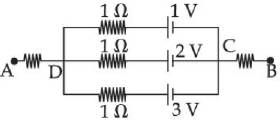
In the circuit shown below, the potential difference between A and B is:
Answer & explanation
Correct answer: option 3
The correct answer is Option (3) → 2 V
A and B are open ends, so no current flows through the resistors next to them. There is no potential drop across those resistors, so \( V_A = V_D \) and \( V_B = V_C \), and the question reduces to the potential difference between D and C.
Between D and C there are three branches in parallel, each a cell in series with \( 1\,\Omega \). In the cell symbol the longer plate is the positive terminal; in all three cells it faces D. Let \( V = V_D - V_C \). The current in each branch from C to D through its cell is \( (E_i - V)/1\,\Omega \), and since no current leaves at D or C these currents add to zero (Kirchhoff's junction rule):
\( \displaystyle \frac{1 - V}{1} + \frac{2 - V}{1} + \frac{3 - V}{1} = 0 \)
\( 6 - 3V = 0 \)
\( V = 2\,\mathrm{V} \)
So \( V_A - V_B = V_D - V_C = 2\,\mathrm{V} \).
Shortcut: For identical internal resistances, cells in parallel act as one cell whose emf is the average of the emfs: \( (1 + 2 + 3)/3 = 2\,\mathrm{V} \).