Match List-I with List-II
| List-I | List-II |
| (A) Aggregate demand (AD) | (I) C/Y |
| (B) Marginal propensity to consume (MPC) | (II) S/Y |
| (C) Average propensity to consume (APC) | (III) C + I |
| (D) Average propensity to save (APS) | (IV) ΔC/ΔY |
Choose the correct answer from the options given below:
Answer & explanation
Correct answer: option 1
The correct answer is Option (1) → (A) – (III), (B) – (IV), (C) – (I), (D) – (II)
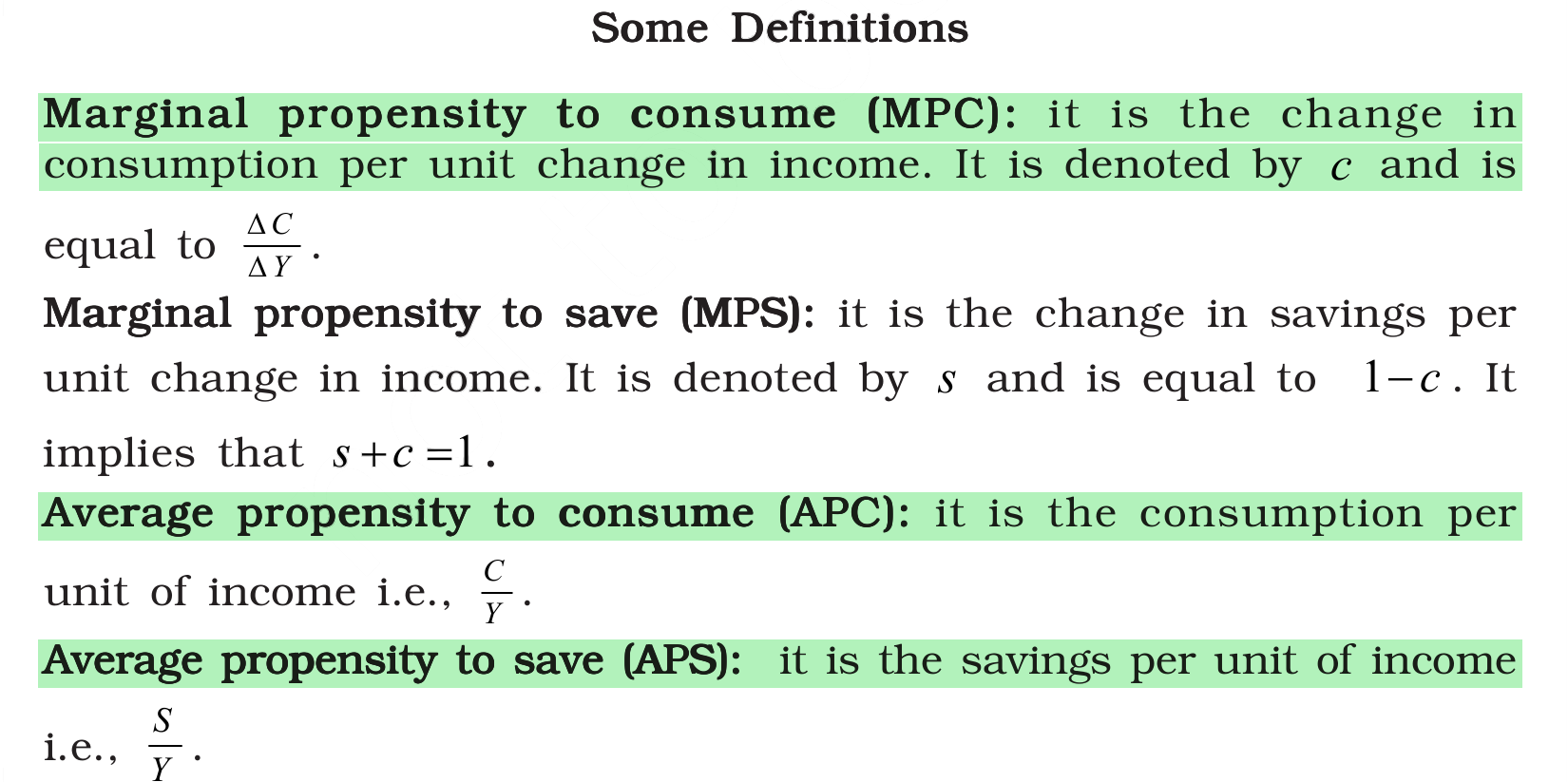
When income rises, people spend part of it and save the rest. Dividing the totals (consumption or saving by income) gives the average propensities; dividing the changes gives the marginal propensity. Aggregate demand is not a ratio at all but the sum of planned spending.
(A) Aggregate demand (AD) — this matches (III) C + I. In an economy without a government, the demand for final goods is the sum of planned consumption expenditure and planned investment expenditure, so AD = C + I.
(B) Marginal propensity to consume (MPC) — this matches (IV) ΔC/ΔY. MPC is the change in consumption per unit change in income. If income rises by Rs. 100 and consumption by Rs. 80, the MPC is 0.8.
(C) Average propensity to consume (APC) — this matches (I) C/Y. APC is consumption per unit of income, the total consumption divided by the total income at that level of income.
(D) Average propensity to save (APS) — this matches (II) S/Y. APS is saving per unit of income. Since income is either consumed or saved, APC + APS = 1.
NCERT: Introductory Macroeconomics — Chapter 4: Determination of Income and Employment (2025-26)
|