Alcohols can be prepared in many ways. They are prepared from alkenes by acid-catalysed hydration and by hydroboration–oxidation. Alcohols are also prepared from aldehydes and ketones by reduction. The reduction of carboxylic acids and esters also gives alcohols. Alcohols are produced by the reaction of Grignard reagents with aldehydes and ketones. Phenol, also known as carbolic acid, was first isolated in the early nineteenth century from coal tar. Nowadays, phenol is commercially produced synthetically. In the laboratory, phenols are prepared from benzene derivatives in many ways.
What type of reaction converts an alkyl halide into an alcohol on treatment with aqueous KOH?
Answer & explanation
Correct answer: option 2
The correct answer is Option (2) → Substitution reaction
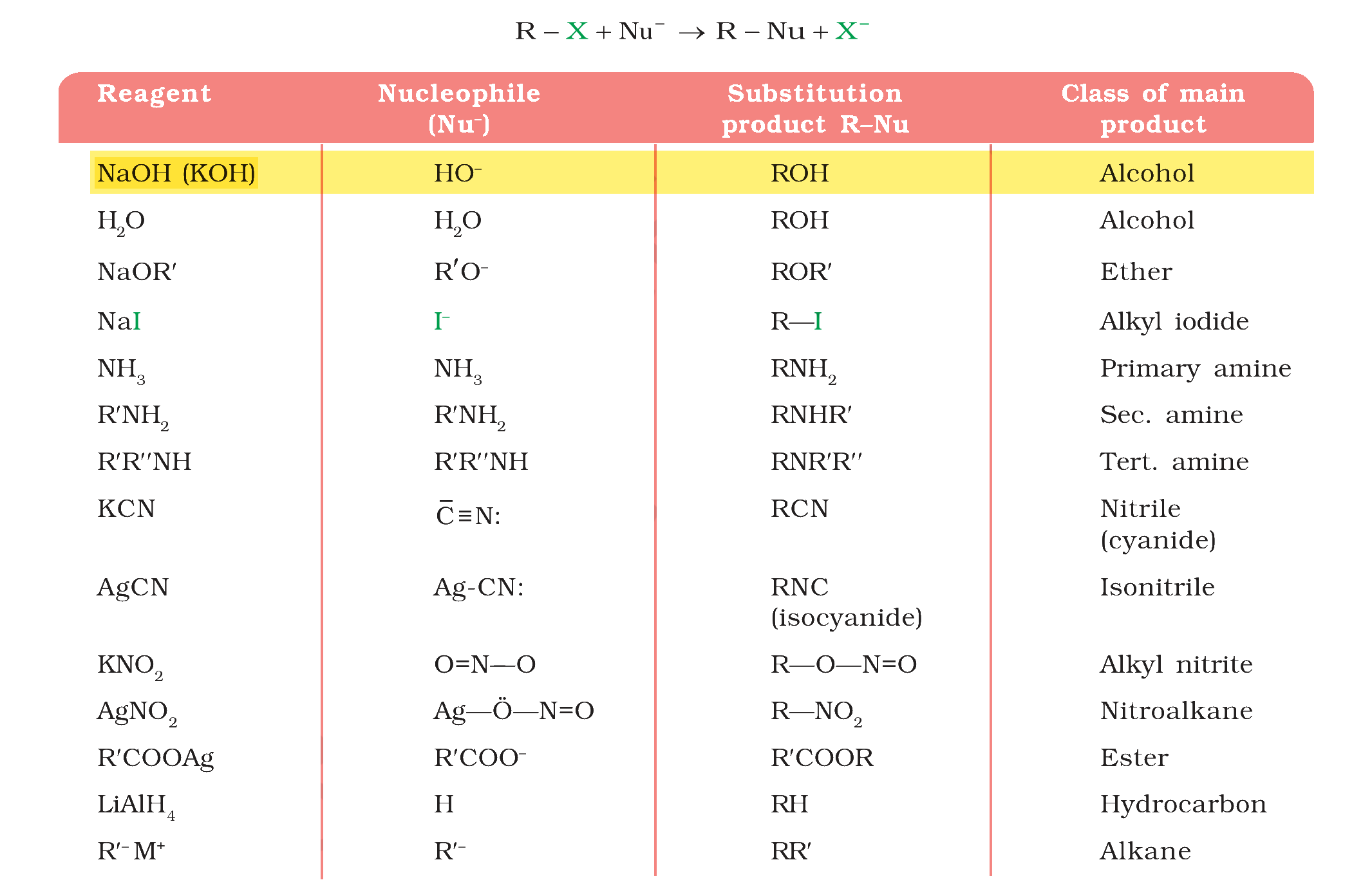
In aqueous KOH the hydroxide ion is the nucleophile. It attacks the carbon bonded to the halogen, which carries a partial positive charge, and the halogen leaves as a halide ion. The –OH group takes the place of the halogen, so this is a nucleophilic substitution. For example:
\( \displaystyle \ce{CH3CH2Cl + KOH} \xrightarrow{\text{aq.}} \ce{CH3CH2OH + KCl} \)
Why the other options are incorrect
Option (1) Addition reaction — Incorrect. An addition needs a multiple bond to add across; an alkyl halide has none, and here one group replaces another.
Option (3) Elimination reaction — Incorrect. Elimination of HX from an alkyl halide gives an alkene, mainly with alcoholic KOH; aqueous KOH gives the alcohol.
Option (4) Dehydrogenation reaction — Incorrect. Dehydrogenation removes hydrogen; here the halogen is replaced by –OH and no hydrogen is lost.
NCERT (2026-27 edition):
6.7.1 Reactions of Haloalkanes – “… The reaction in which a nucleophile replaces already existing nucleophile in a molecule is called nucleophilic substitution reaction.”
“… The products formed by the reaction of haloalkanes with some common nucleophiles are given in Table 6.4.”
Table 6.4: Nucleophilic Substitution of Alkyl Halides (R–X)