Which of the following is an ambident nucleophile?
Answer & explanation
Correct answer: option 2
The correct answer is Option (2) → \(\overline{\mathrm{C}}\equiv \mathrm{N}:\)
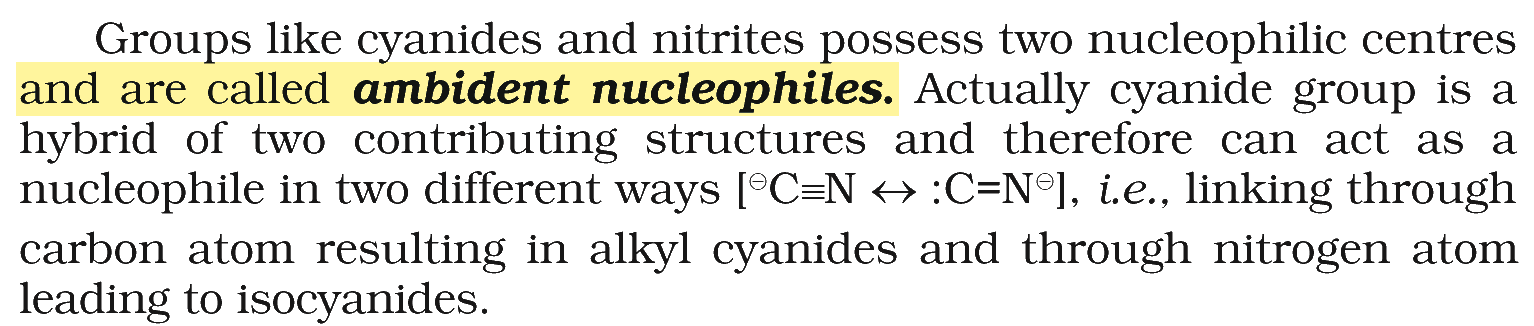
A nucleophile is an electron-rich species that donates a pair of electrons. An ambident nucleophile has two different atoms that can donate electrons, and it can attack through either one. Common examples are the cyanide ion and the nitrite ion.
The cyanide ion, \( \ce{^{-}C} \)≡N:, can attack through carbon or through nitrogen. Which atom attacks depends on the reagent:
KCN is ionic, so the free cyanide ion attacks through carbon, giving an alkyl cyanide (R–CN).
AgCN is mainly covalent, so the carbon is not free and attack occurs through the nitrogen lone pair, giving an isocyanide (R–NC).
So the cyanide ion is the ambident nucleophile.
Why the other options are incorrect
Option (1) \(:\overline{\mathrm{O}}\mathrm{H}\) — Incorrect. The hydroxide ion can donate only through its oxygen atom.
Option (3) \(\ddot{\mathrm{N}}\mathrm{H_3}\) — Incorrect. Ammonia has only one donor atom, the nitrogen with its lone pair.
Option (4) \(\mathrm{H_2}\ddot{\mathrm{O}}:\) — Incorrect. Water can donate only through its oxygen atom.
NCERT (2026-27 edition):
Reactions of Haloalkanes – …