From the following information, calculate the earnings per share (EPS) of the company:
| Total funds used | Rs. 40 lakh |
| Debt (rest raised by equity shares of Rs. 10 each) | Rs. 20 lakh |
| Rate of interest on debt | 12% p.a. |
| EBIT | Rs. 6 lakh |
| Tax rate | 25% |
Answer & explanation
Correct answer: option 1
The correct answer is Option (1) → Rs. 1.35
Given:
Debt = Rs. 20 lakh at 12% p.a.
Equity = Rs. 40 lakh − Rs. 20 lakh = Rs. 20 lakh
Number of shares = Rs. 20 lakh ÷ Rs. 10 = 2,00,000
EBIT = Rs. 6 lakh; Tax rate = 25%
EPS = Earnings after tax ÷ Number of equity shares
Interest = 12% of Rs. 20 lakh = Rs. 2.4 lakh
EBT = 6 − 2.4 = Rs. 3.6 lakh
Tax = 25% of 3.6 = Rs. 0.9 lakh
EAT = 3.6 − 0.9 = Rs. 2.7 lakh
EPS = Rs. 2,70,000 ÷ 2,00,000 shares = Rs. 1.35
Option (2) Rs. 1.80 — Incorrect. This leaves out the tax: Rs. 3,60,000 ÷ 2,00,000 = Rs. 1.80.
Option (3) Rs. 2.25 — Incorrect. This leaves out the interest: tax is taken on the full EBIT, so (6 − 1.5) = Rs. 4.5 lakh ÷ 2,00,000 = Rs. 2.25.
Option (4) Rs. 0.68 — Incorrect. This divides by 4,00,000 shares, as if all Rs. 40 lakh were equity: Rs. 2,70,000 ÷ 4,00,000 = Rs. 0.675.
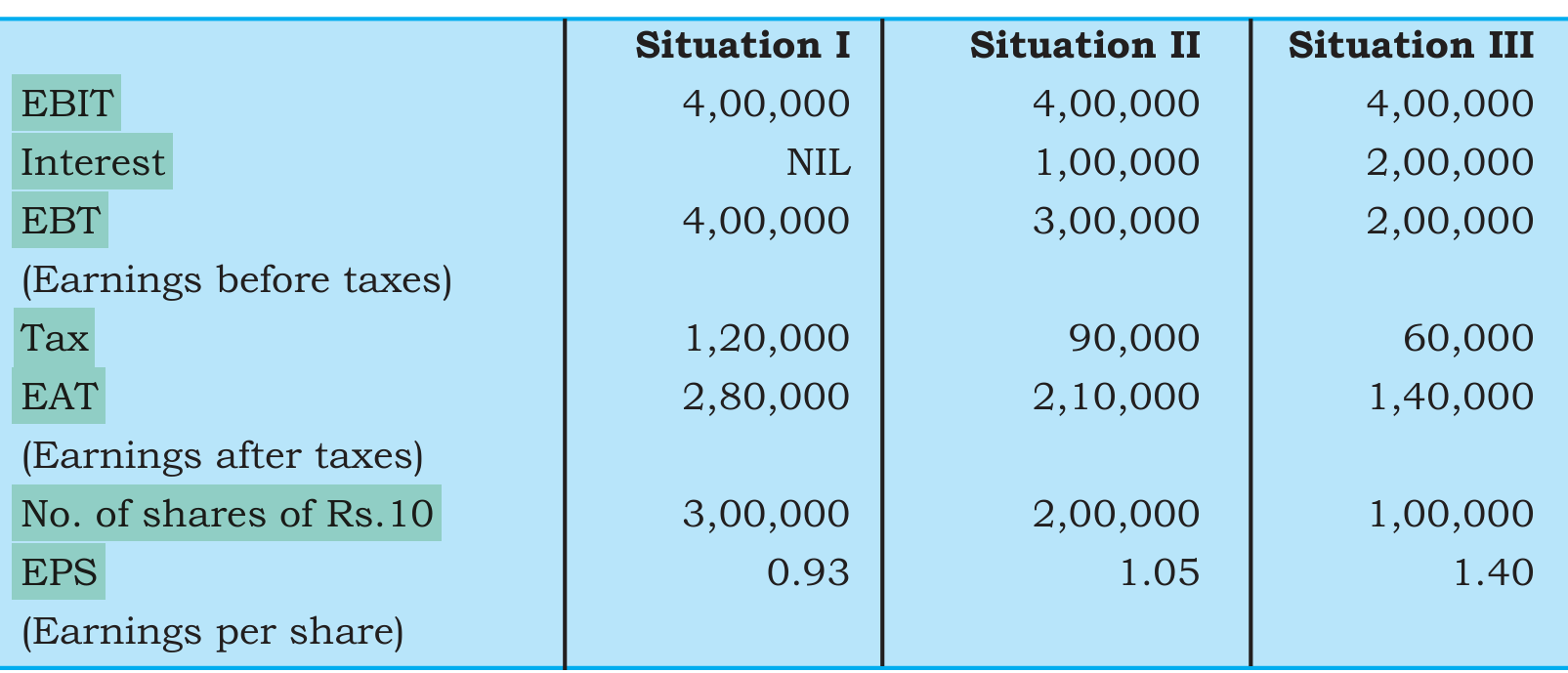
NCERT (2026-27 Edition): “EBIT-EPS Analysis … The impact of financial leverage on the profitability of a business can be seen through EBIT-EPS (Earning before Interest and Taxes-Earning per Share) analysis as in the following example. …”
|