
CUETMOCK
  • Pricing
  • Mentors
Log inStart freeStart free mocks→

First test, then trust

Try a free CUET mock test.

Join 5,00,000+ students who rehearsed exam day on the exact NTA screen before sitting CUET. On the web and on Android.

Start free mocks →Get the Android app
CUETMOCK

India's #1 CUET Mock Test Platform. Original NCERT-based questions on the exact NTA exam screen — trusted by 5,00,000+ students since CUET 2022.

Get it onGoogle PlayScan to download the CUETMOCK app

Mock tests

  • CUET mock test series
  • Commerce mocks
  • Humanities (Arts) mocks
  • Science mocks
  • Languages & GAT mocks
  • Free practice questions
  • Pricing

Resources

  • CUET exam guide
  • CUET syllabus
  • Universities accepting CUET
  • Expert blogs
  • News & notifications
  • Webinars & counselling
  • CUET score calculator
  • How we estimate your rank
  • FAQs

Company

  • About us
  • Our leadership & team
  • Our toppers
  • Mentors
  • For schools
  • Contact us
  • Terms
  • Privacy
  • Refund policy

Talk to us

+91 7696 6630 56info@cuetmock.comWhatsApp us

Our other platforms

  • JEE Mock — For IIT-JEE aspirants
  • NEET Mock — For NEET aspirants

Newsletter

Exam updates, study material and offers — no spam.

© 2026 NYC Ventures Pvt. Ltd.

701-702, Royal Business Park, Zirakpur, Punjab - 140603

  • Terms of use
  • Privacy policy
  • Refund policy
  • Contact us

iCUETMOCK is an independent preparation platform, not affiliated with the National Testing Agency (NTA). Always check exam details on the official NTA website.

  • Home
  • Mock tests
  • CUET guide
  • Pricing
  • Log in
Home/Practice questions/Chemistry
ChemistryInorganic: Coordination Compounds

Which one of the following complexes exhibits optical isomerism?

Stereoisomers are those isomers that have the same molecular formula and chemical bonds but they have different spatial arrangements of atoms. As already mentioned, stereoisomerism involves two types of isomerism viz., geometrical isomerism and optical isomerism. These are discussed below:

1. Geometrical isomerism

Geometrical isomerism arises in heteroleptic complexes due to ligands occupying different positions around the central ion. The ligands occupy positions either adjacent to one another or opposite to one another. These are referred to as cis-form (ligands occupy adjacent positions) and trans- form (ligands occupy opposite positions). This type of isomerism is, therefore, also referred to as cis-trans isomerism.

2. Optical isomerism

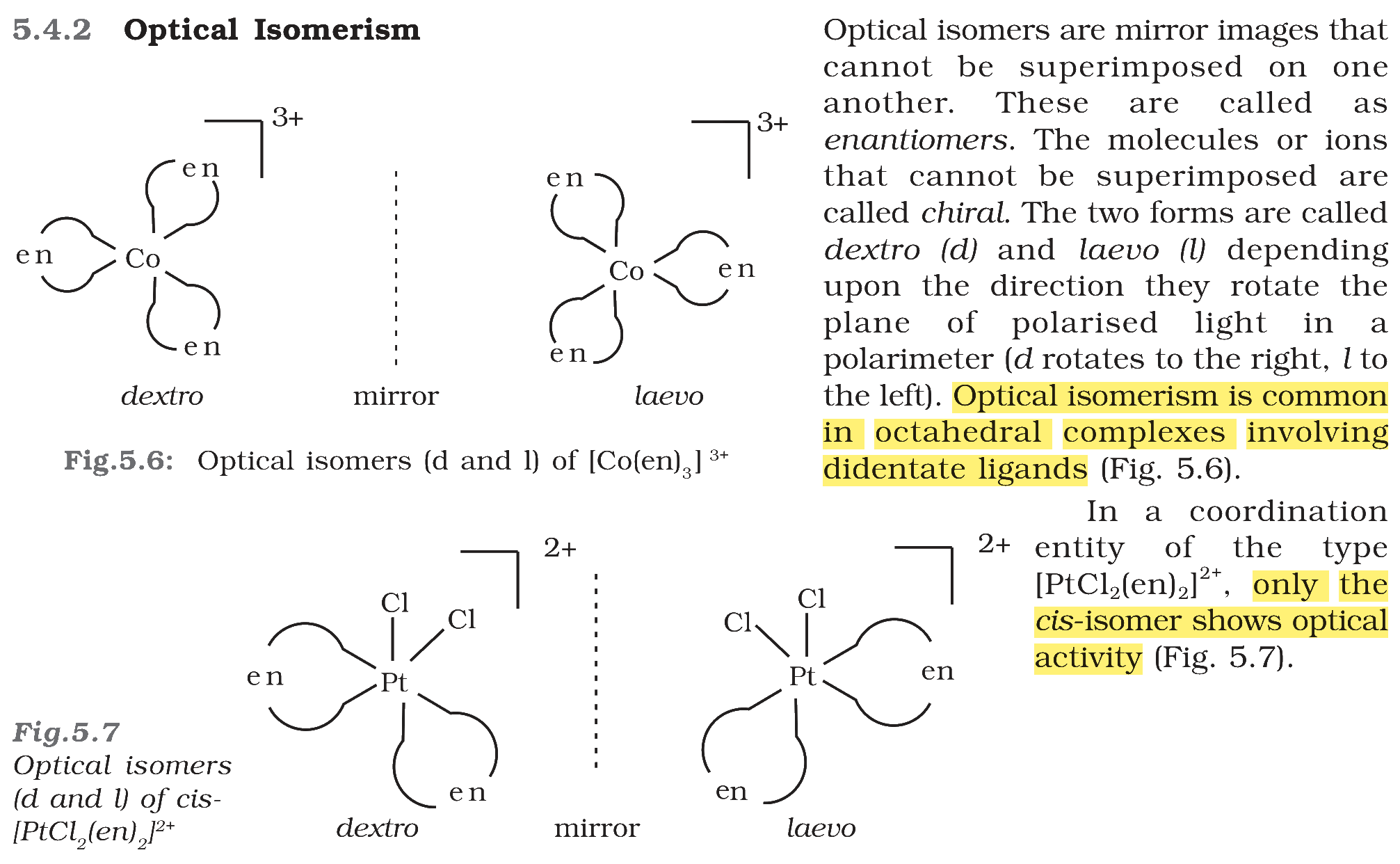
The isomers which rotate the plane of polarised light equally but in opposite directions are called optically active isomers. These are also called enantiomers or enantiomorphs. The d and l isomers are mirror images of each other just as left hand is mirror image of the right hand. These mirror image compounds are non-superimposable on each other and do not possess the plane of symmetry.

Which one of the following complexes exhibits optical isomerism?

Answer & explanation+

Correct answer: option 2

The correct answer is Option (2) → cis-[Co(NH3)2(C2O4)2]–

  • A complex shows optical isomerism when its mirror image cannot be superimposed on it.

  • In cis-\( \ce{[Co(NH3)2(C2O4)2]^-} \) the two oxalate ions (\( \ce{C2O4^2-} \), each didentate) and the two \( \ce{NH3} \) ligands in cis positions give a complex whose mirror image cannot be superimposed on it. It exists as a d and an l form, just like cis-\( \ce{[PtCl2(en)2]^2+} \).

Why the other options are incorrect

Option (1) trans-[Cr(NH3)4(SCN)2]+ — Incorrect. It has only unidentate ligands, and the two SCN groups lie opposite each other. Its mirror image can be superimposed on it, so the complex is optically inactive.

Option (3) trans-[Co(NH3)2(C2O4)2]– — Incorrect.

  • With the two \( \ce{NH3} \) ligands opposite each other, both oxalate rings lie in one plane through the metal.

  • The trans form can be superimposed on its mirror image and is optically inactive; as with \( \ce{[PtCl2(en)2]^2+} \), only the cis form is optically active.

Option (4) cis-[Pt(gly)2] — Incorrect. Pt(II) with four donor atoms is square planar. A flat complex can be superimposed on its mirror image, so it shows geometrical isomerism (cis and trans) but no optical isomerism.

NCERT (2026-27 edition):
5.4.2 Optical Isomerism
Textbook extract

Advertisement

Practise more on Inorganic: Coordination Compounds

Chapter-wise mocks on the real NTA exam screen, with solutions and your rank. Your first mocks are free.

Start free mocks →

Advertisement

Next questions

  1. Which of the following sentences use a simile?(A) Nani’s voice on the phone was as warm as a cup of morning chai.(B) The new metro line is…English · Figure of Speech
  2. A long straight solid wire of radius 3 mm carries a steady current of 18 A. The current is spread uniformly over its cross-section. A circl…Physics · Moving Charges and Magnetism
  3. The present value of a perpetuity of Rs. 900 payable at the end of each year, if money is worth 6% per annum, is:Applied Maths. Section B2 · Financial Mathematics
  4. Who founded the township of ‘Nagalapuram’ after his mother?History · Medieval India: An Imperial Capital: Vijayanagara
  5. If x^3 + y^3 = 28 , then the value of displaystyledy/dx at the point (3, 1) isMaths. Section B1 · Continuity and Differentiability
  6. A square piece of paper is folded as shown by the dotted lines and the arrows, and the folded paper is punched as shown in the last figure.…General Aptitude Test · Non-Verbal Reasoning
  7. Select the Venn diagram that best represents the relationship between the following classes.Squares, Quadrilaterals, RectanglesGeneral Aptitude Test · Verbal Reasoning
  8. Find the missing step in this chain:Formal credit requires some kind of collateral → [ ? ] → Self-Help Groups emerge to fill the gap in the…Economics · Indian Economic Development: Rural Development
  9. छंदशास्त्र के अनुसार अनुस्वार युक्त वर्ण के विषय में कौन-सा कथन सही है?Hindi · छंद
  10. Identify the part of the sentence that contains an error. If there is no error, choose ‘No error’.With the exam just two days away, / Pari…English · Spot Error