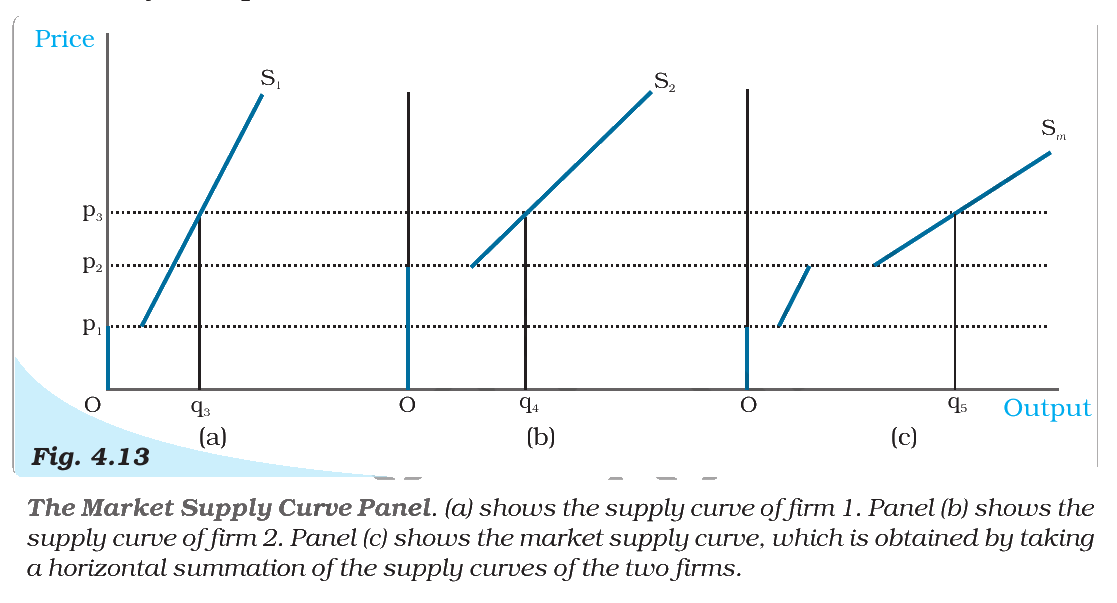
A market has two firms. Firm 1 produces zero output for prices below p1, and firm 2 for prices below p2, where p2 is greater than p1. Consider the following statements:
(A) At a price p3 above p2, market supply is the larger of the two firms’ outputs at p3.
(B) For prices from p1 to below p2, the market supply curve coincides with the supply curve of firm 1.
(C) At a price p3 above p2, market supply is the sum of the outputs of the two firms at p3.
(D) For prices from p1 to below p2, both firms produce a positive output.
(E) For prices below p1, market supply is zero.
Which of the statements given above are correct?
Choose the correct answer from the options given below:
Answer & explanation
Correct answer: option 3
The correct answer is Option (3) → (B), (C) and (E) only
Market supply at any price is the sum of what each firm supplies at that price. A firm that is not producing adds nothing.
(A) At a price p3 above p2, market supply is the larger of the two firms’ outputs at p3. — Incorrect. Both firms produce at p3, so their outputs are added, not compared.
(B) For prices from p1 to below p2, the market supply curve coincides with the supply curve of firm 1. — Correct. In this range only firm 1 produces, so market supply equals its supply.
(C) At a price p3 above p2, market supply is the sum of the outputs of the two firms at p3. — Correct. This is the horizontal summation of the two supply curves.
(D) For prices from p1 to below p2, both firms produce a positive output. — Incorrect. Firm 2 produces nothing at prices below p2.
(E) For prices below p1, market supply is zero. — Correct. Neither firm produces below p1, so the sum is zero.
NCERT (2026-27):
|