
The figure shows aqueous solutions of complexes of nickel(II) with an increasing number of ethane-1,2-diamine (en) ligands.
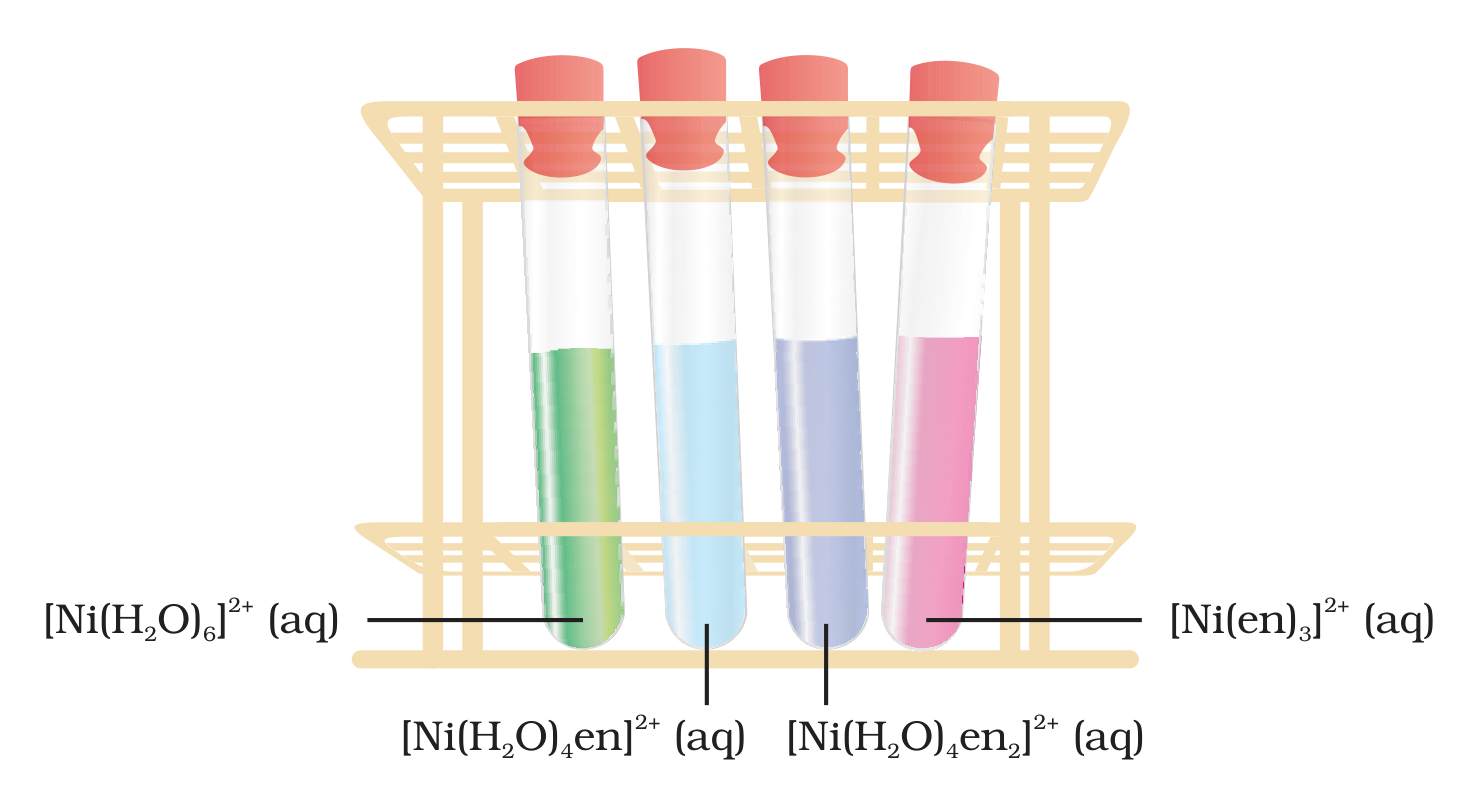
In going from the first solution (on the left) to the second solution, one en ligand enters the complex. How many water molecules does this one en ligand replace?
Answer & explanation
Correct answer: option 1
The correct answer is Option (1) → 2
The first solution is [Ni(H2O)6]2+ and the second is [Ni(H2O)4(en)]2+. The number of water ligands falls from 6 to 4 when one en enters, so one en replaces 2 water molecules. en is a didentate ligand: it binds through its two nitrogen atoms and takes two places round nickel.
\( \ce{[Ni(H2O)6]^2+ + en -> [Ni(H2O)4(en)]^2+ + 2H2O} \)
(The label of the third solution in the figure reads [Ni(H2O)4en2]2+; the correct formula, as in the equations below, is [Ni(H2O)2(en)2]2+.)
NCERT (2026-27 edition):
5.5.5 Colour in Coordination Compounds – “The influence of the ligand on the colour of a complex may be illustrated by considering the [Ni(H2O)6]2+ complex, which forms when nickel(II) chloride is dissolved in water. If the didentate ligand, ethane-1,2-diamine(en) is progressively added in the molar ratios en:Ni, 1:1, 2:1, 3:1, the following series of reactions and their associated colour changes occur:”
[Ni(H2O)6]2+ (aq) green + en (aq) = [Ni(H2O)4(en)]2+(aq) pale blue + 2H2O
[Ni(H2O)4(en)]2+(aq) + en (aq) = [Ni(H2O)2(en)2]2+(aq) blue/purple + 2H2O
[Ni(H2O)2(en)2]2+(aq) + en (aq) = [Ni(en)3]2+(aq) violet + 2H2O
“This sequence is shown in Fig. 5.11.”
Fig. 5.11: Aqueous solutions of complexes of nickel(II) with an increasing number of ethane-1, 2-diamine ligands.