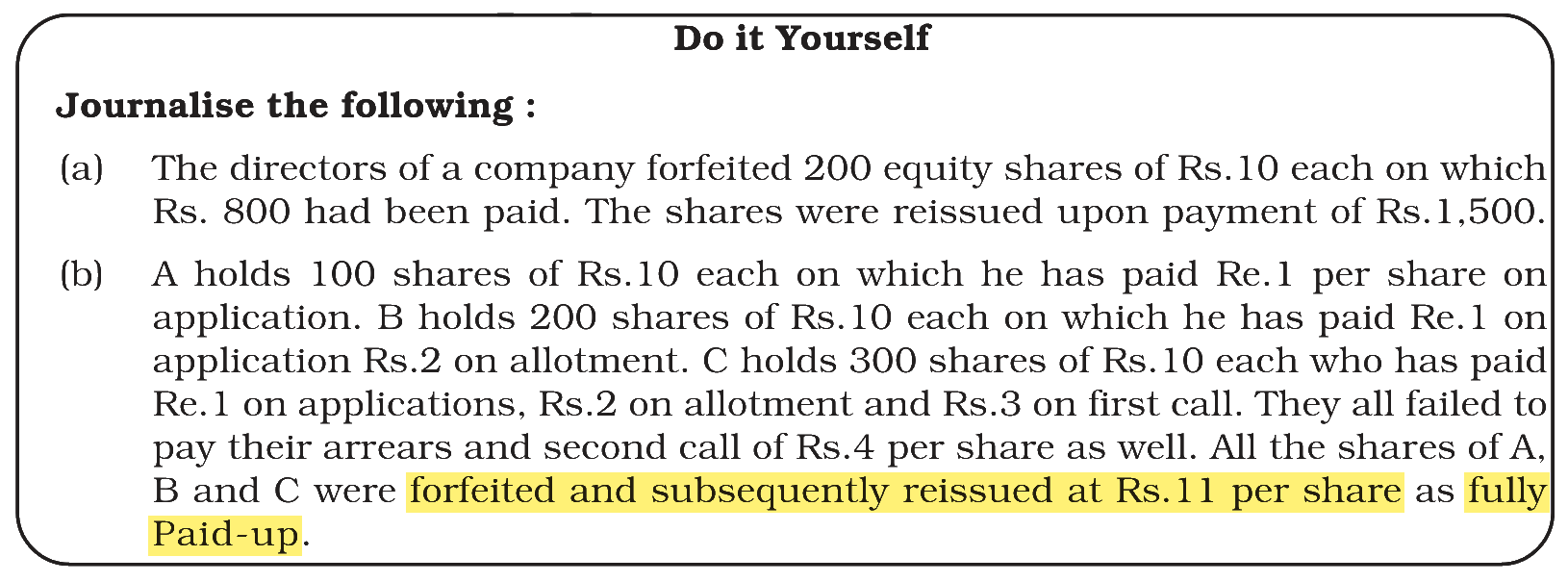
A holds 300 shares of Rs. 10 each on which he has paid Re. 1 per share on application. B holds 300 shares of Rs. 10 each on which he has paid Re. 1 on application and Rs. 2 on allotment. C holds 300 shares of Rs. 10 each, who has paid Re. 1 on applications, Rs. 2 on allotment and Rs. 3 on first call. They all failed to pay their arrears and the second call of Rs. 4 per share as well. All the shares of A, B and C were forfeited and subsequently reissued at Rs. 11 per share as fully paid-up. The journal entries for the reissue of shares and transfer to capital reserve would be:
Answer & explanation
Correct answer: option 3
The correct answer is Option (3) → Bank A/c Dr. Rs. 9,900 to Share Capital A/c Rs. 9,000 and Securities Premium A/c Rs. 900; then Share Forfeiture A/c Dr. Rs. 3,000 to Capital Reserve A/c Rs. 3,000
On reissue, Share Capital is credited only with the face value of the shares; anything received above it is Securities Premium. The amount already forfeited stays in Share Forfeiture A/c, and once all the forfeited shares are reissued at no discount, the whole balance is a capital profit and goes to Capital Reserve.
Amount forfeited (money already paid by the defaulters):
A: 300 × Re. 1 = Rs. 300
B: 300 × Rs. 3 = Rs. 900
C: 300 × Rs. 6 = Rs. 1,800
Share Forfeiture A/c = Rs. 3,000
Reissue of 900 shares at Rs. 11 as fully paid:
Bank = 900 × Rs. 11 = Rs. 9,900
Share Capital = 900 × Rs. 10 = Rs. 9,000
Securities Premium = Rs. 9,900 − Rs. 9,000 = Rs. 900
Transfer to Capital Reserve = Rs. 3,000 (the full forfeiture balance, as no discount was allowed)
Bank A/c Dr. 9,900
To Share Capital A/c 9,000
To Securities Premium A/c 900
Share Forfeiture A/c Dr. 3,000
To Capital Reserve A/c 3,000
Note: NTA picked this question from an NCERT (2026-27) exercise and changed the figures. Do not ignore NCERT while practising numericals.
NCERT (2026-27 edition):
|