
CUETMOCK
  • Pricing
  • Mentors
Log inStart freeStart free mocks→

First test, then trust

Try a free CUET mock test.

Join 5,00,000+ students who rehearsed exam day on the exact NTA screen before sitting CUET. On the web and on Android.

Start free mocks →Get the Android app
CUETMOCK

India's #1 CUET Mock Test Platform. Original NCERT-based questions on the exact NTA exam screen — trusted by 5,00,000+ students since CUET 2022.

Get it onGoogle PlayScan to download the CUETMOCK app

Mock tests

  • CUET mock test series
  • Commerce mocks
  • Humanities (Arts) mocks
  • Science mocks
  • Languages & GAT mocks
  • Free practice questions
  • Pricing

Resources

  • CUET exam guide
  • CUET syllabus
  • Universities accepting CUET
  • Expert blogs
  • News & notifications
  • Webinars & counselling
  • CUET score calculator
  • How we estimate your rank
  • FAQs

Company

  • About us
  • Our leadership & team
  • Our toppers
  • Mentors
  • For schools
  • Contact us
  • Terms
  • Privacy
  • Refund policy

Talk to us

+91 7696 6630 56info@cuetmock.comWhatsApp us

Our other platforms

  • JEE Mock — For IIT-JEE aspirants
  • NEET Mock — For NEET aspirants

Newsletter

Exam updates, study material and offers — no spam.

© 2026 NYC Ventures Pvt. Ltd.

701-702, Royal Business Park, Zirakpur, Punjab - 140603

  • Terms of use
  • Privacy policy
  • Refund policy
  • Contact us

iCUETMOCK is an independent preparation platform, not affiliated with the National Testing Agency (NTA). Always check exam details on the official NTA website.

  • Home
  • Mock tests
  • CUET guide
  • Pricing
  • Log in
Home/Practice questions/Chemistry
ChemistryInorganic: Coordination Compounds

The table shows Werner’s formulation of four cobalt(III) chloride–amm…

The table shows Werner’s formulation of four cobalt(III) chloride–ammonia complexes.
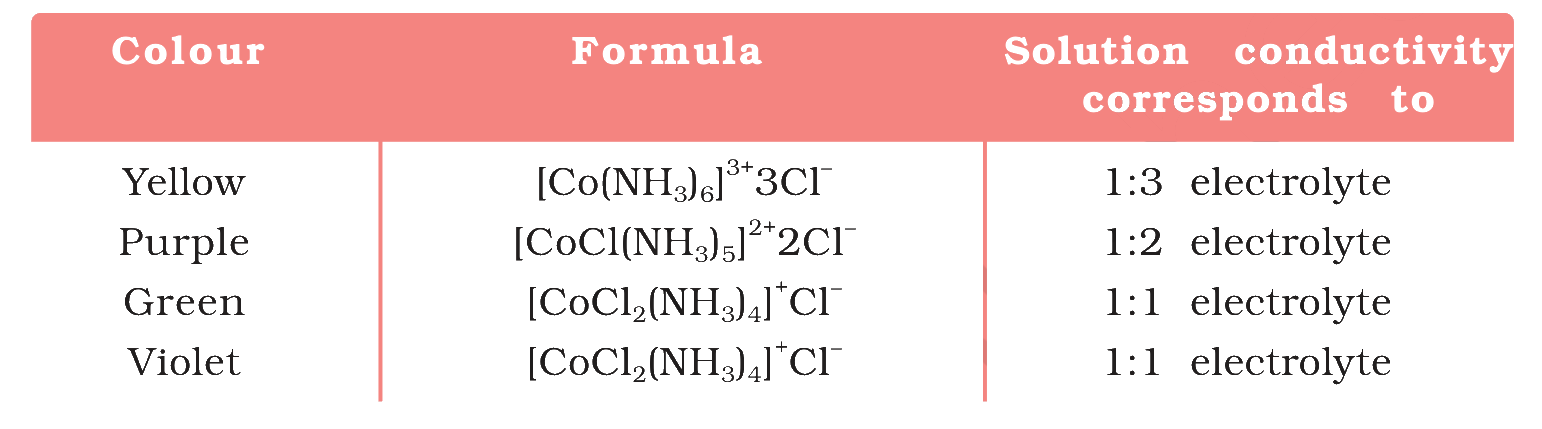
Table of four cobalt(III) chloride-ammonia complexes with their colour, formula and solution conductivity

Aqueous solutions of the four complexes are prepared at the same molar concentration and the same temperature. Which of the following shows the correct order of their molar conductivity?

Answer & explanation+

Correct answer: option 1

The correct answer is Option (1) → Yellow > Purple > Green = Violet

In the same solvent and at the same temperature, the conductivity of electrolyte solutions depends on the charge of the ions and the concentration of ions. In each complex the atoms inside the square brackets stay together as one ion; only the chloride ions outside the brackets are set free as separate ions. So, although every complex has three chlorine atoms per cobalt, the number of ions is not the same.

  • Yellow — \( \ce{[Co(NH3)6]^3+ 3Cl-} \), a 1:3 electrolyte. One formula unit gives 4 ions, and the complex cation carries a 3+ charge, so its molar conductivity is the highest.

  • Purple — \( \ce{[CoCl(NH3)5]^2+ 2Cl-} \), a 1:2 electrolyte. One formula unit gives 3 ions, and the complex cation carries a 2+ charge.

  • Green and Violet — both \( \ce{[CoCl2(NH3)4]^+ Cl-} \), 1:1 electrolytes. Each formula unit gives 2 ions of the same kinds, so their molar conductivities are equal and the lowest of the four.

NCERT (2026-27 edition):
5.1 Werner’s Theory of Coordination Compounds – “These observations, together with the results of conductivity measurements in solution can be explained if (i) six groups in all, either chloride ions or ammonia molecules or both, remain bonded to the cobalt ion during the reaction and (ii) the compounds are formulated as shown in Table 5.1, where the atoms within the square brackets form a single entity which does not dissociate under the reaction conditions.”

2.4.1 Measurement of the Conductivity of Ionic Solutions – “The conductivity of solutions of different electrolytes in the same solvent and at a given temperature differs due to charge and size of the ions in which they dissociate, the concentration of ions or ease with which the ions move under a potential gradient.”
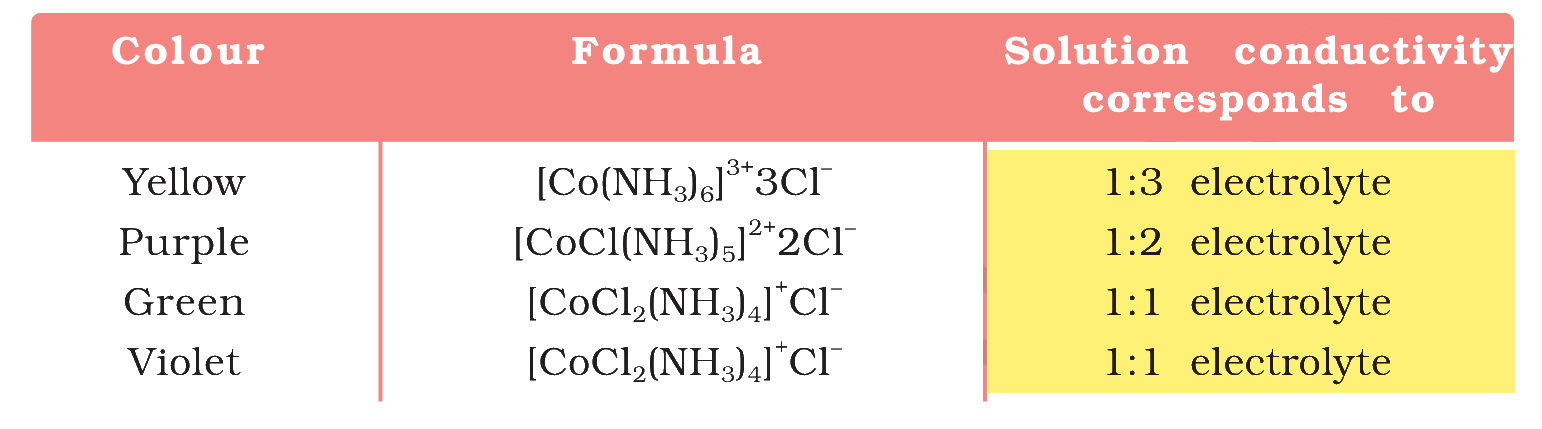
Table 5.1

Table 5.1: Formulation of Cobalt(III) Chloride-Ammonia Complexes

Advertisement

Practise more on Inorganic: Coordination Compounds

Chapter-wise mocks on the real NTA exam screen, with solutions and your rank. Your first mocks are free.

Start free mocks →

Advertisement

Next questions

  1. The value of ∫_0^1√((1-x)/(1+x)) dx isMaths. Section B1 · Definite Integration
  2. The word ‘incredulity’, as used in the passage, means:English · Comprehension - (Narrative / Factual)
  3. A flat square of area A is placed in a uniform electric field E . Match the position of the square in List-I with the electric flux through…Physics · Electric Charges and Fields
  4. The de Broglie wavelength of an electron moving with a speed of 1.5×10^7 mathrmm s^-1 is equal to that of a photon. The ratio of the kineti…Physics · Dual Nature of Radiation and Matter
  5. The figure shows the nominal GDP and the real GDP of a country over five years.Which year is most likely the base year used to calculate th…Economics · Macro Economics: National Income Accounting
  6. Choose the word which is different from the rest.General Aptitude Test · Verbal Reasoning
  7. The angle between a and b , where ≤ft|a|=√3 and ≤ft|b|=2 and a·b=√6 , is:Maths. Section B1 · Vectors
  8. Indian residents working for a few weeks on a contract abroad earn wages of Rs 50 crore from foreign firms. Other things remain the same. W…Economics · Macro Economics: National Income Accounting
  9. 'ज्ञात' का विलोम शब्द है -Hindi · विलोम शब्द
  10. A train is moving due north with a speed of 30 mathrmm s^-1 on rails 2 m apart. If the vertical component of the earth’s magnetic field the…Physics · Electromagnetic Induction