Comprehension:
Solutions
Let us consider a binary solution of two volatile liquids and denote the two components as 1 and 2. When taken in a closed vessel, both the components would evaporate and eventually an equilibrium would be established between vapour phase and the liquid phase. Let the total vapour pressure at this stage be ptotal and p1 and p2 be the partial vapour pressures of the two components 1 and 2 respectively. These partial pressures are related to the mole fractions x1 and x2 of the two components 1 and 2 respectively. The French chemist, Francois Marie Raoult (1886) gave the quantitative relationship between them. The relationship is known as the Raoult's law which states that for a solution of volatile liquids the partial vapour pressure of each component of the solution is directly proportional to its mole fraction (x1) present in solution.
When phenol and aniline are mixed, their boiling points become greater than both of them. The mixture is :
Answer & explanation
Correct answer: option 2
The correct answer is Option (2) → non-ideal solution with negative deviation from Raoult's law
A solution obeys Raoult’s law when the attractions between unlike molecules (A–B) equal those between like molecules (A–A, B–B). When they differ, the solution is non-ideal:
Positive deviation: A–B attractions are weaker, the vapour pressure is higher than expected, and the boiling point is lower. A large positive deviation gives a minimum boiling azeotrope.
Negative deviation: A–B attractions are stronger, the vapour pressure is lower than expected, and the boiling point is higher. A large negative deviation gives a maximum boiling azeotrope.
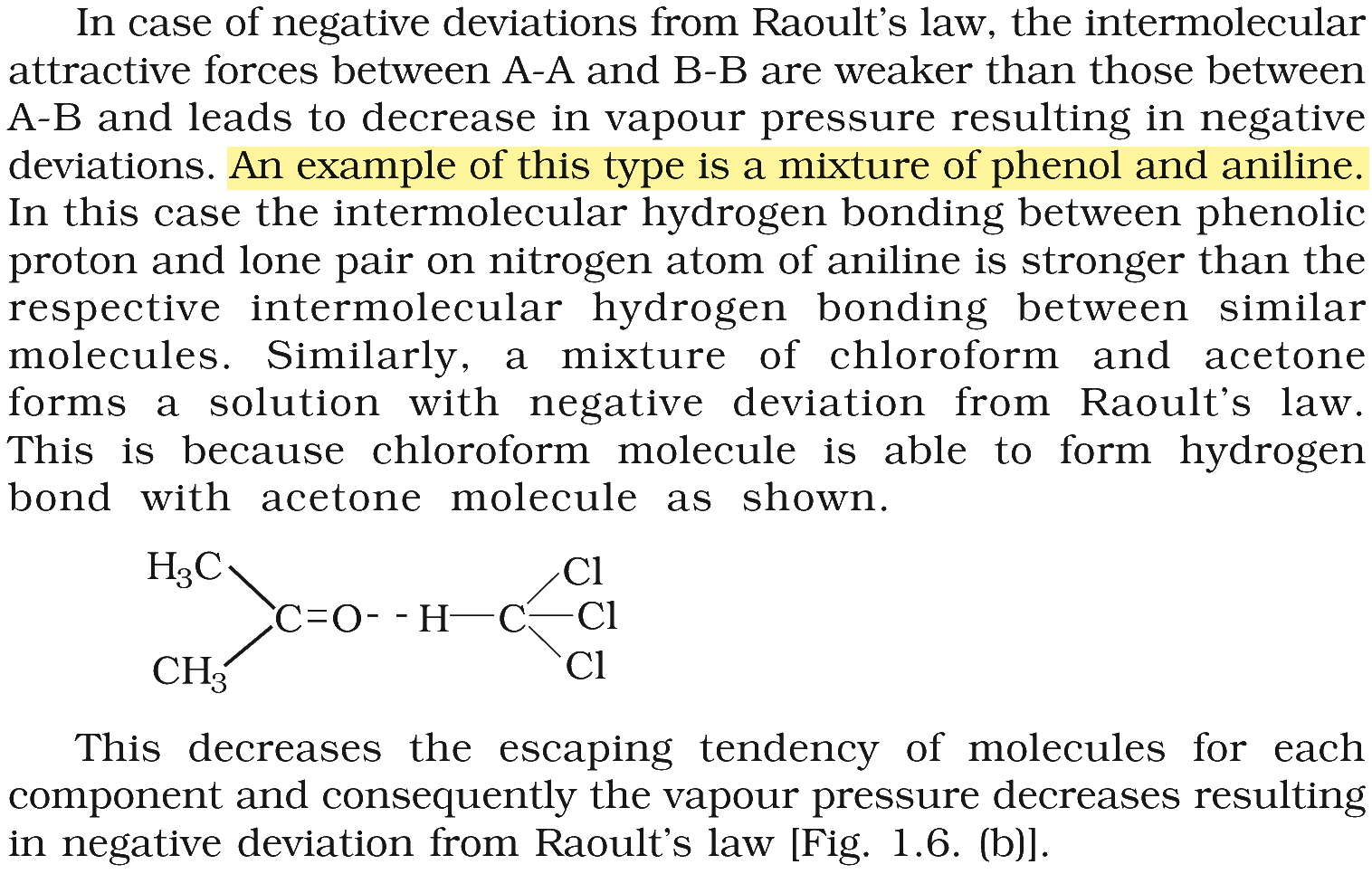
In a mixture of phenol and aniline, the O–H of phenol forms a hydrogen bond with the nitrogen of aniline, which is stronger than the attractions in the pure liquids:
\( \ce{C6H5-O-H} \)…\( \ce{NH2-C6H5} \)
The molecules escape less easily, the vapour pressure falls, and the boiling point rises above that of both liquids. So the mixture is a non-ideal solution with negative deviation from Raoult’s law.
Why the other options are incorrect
Option (1) ideal solution — Incorrect. An ideal solution has no change in intermolecular forces (ΔmixH = 0), so its boiling point lies between those of the two liquids.
Option (3) non-ideal solution with positive deviation from Raoult's law — Incorrect. Positive deviation raises the vapour pressure and lowers the boiling point.
Option (4) Azeotropic — Incorrect. An azeotrope forms only at one particular composition; the phenol–aniline mixture in general is described by its negative deviation, of which the maximum boiling azeotrope is one consequence.
NCERT (2026-27 edition):
Non-ideal Solutions – …