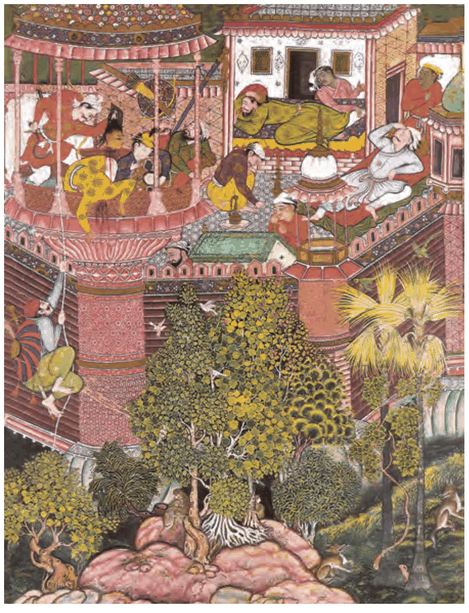
To which period does the Hamza Nama painting Spies Attack the City of Kaymar belong?
Answer & explanation
Correct answer: option 2
The correct answer is Option (2) → 16th century
Spies Attack the City of Kaymar, a Hamza Nama painting, is dated 1567–82, which falls in the 16th century.
Note: This topic was not named in the CUET 2026 syllabus, but it was part of the NCERT chapter. In 2025 and 2026, NTA also asked questions on topics in NCERT that the CUET syllabus did not name. So our mocks have questions from every part of the NCERT chapter, to give you enough practice. Read the whole chapter, not only the sub-topics named in the syllabus.
NCERT (2026-27): “Early Mughal Painting …The painted folios of Hamza Nama are scattered all over the world and housed in various collections. It is recorded to have consisted of 14 volumes with 1400 illustrations and took nearly 15 years to be completed. The suggested date of this magnificent project is 1567–1582 and was completed under the supervision of two Persian masters — Mir Sayyid Ali and Abd us Samad. In Hamza Nama painting, Spies Attack the City of Kaymar (1567–82), the space is sharply cut and divided so as to facilitate visual reading of the narrative.”
Spies of Hamza attack the City of Kaymar, 1567–1582, Museum of Applied Arts, Vienna |