Match the colonial-period paintings in List-I with their artists in List-II.
List-I (Painting) | List-II (Artist) |
A. Radhika | I. Abanindranath Tagore |
B. Journey’s End | II. Ghulam Ali Khan |
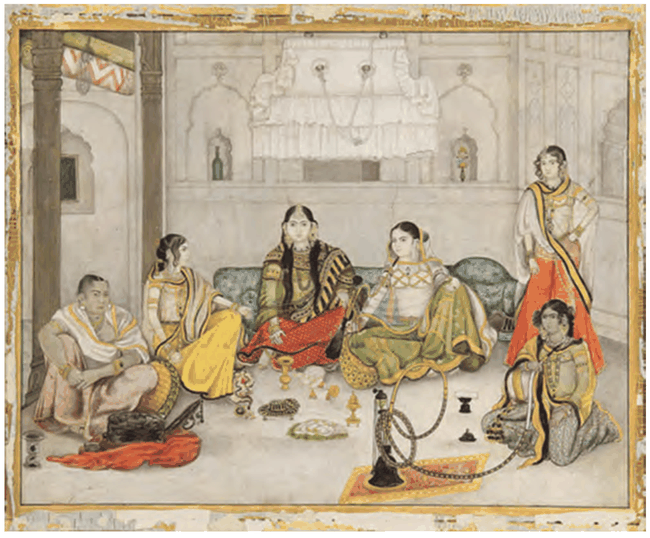
C. Group of Courtesans | III. M. R. Chughtai |
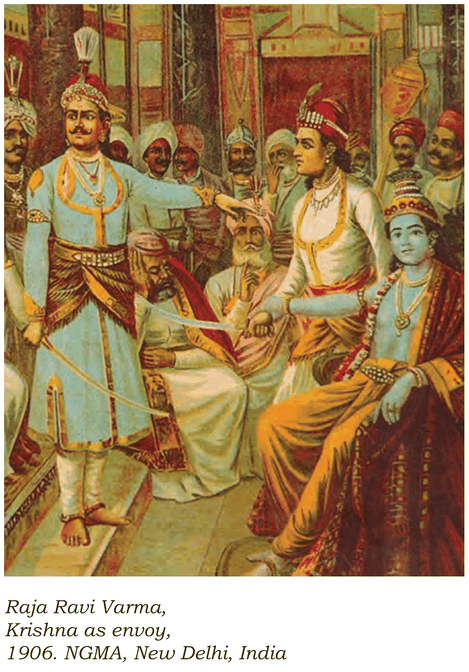
D. Krishna as envoy | IV. Raja Ravi Varma |
Choose the correct answer from the options given below:
Answer & explanation
Correct answer: option 4
The correct answer is Option (4) → A-III, B-I, C-II, D-IV
| List-I | List-II | Reason |
|---|---|---|
| (A) Radhika | (III) M. R. Chughtai | Chughtai was one of the younger artists who followed the new direction opened by Abanindranath. Radhika is his work. |
| (B) Journey’s End | (I) Abanindranath Tagore | His Journey’s End shows the influence of Mughal and Pahari miniatures. |
| (C) Group of Courtesans | (II) Ghulam Ali Khan | Ghulam Ali Khan painted it in the Company style. |
| (D) Krishna as envoy | (IV) Raja Ravi Varma | Ravi Varma of the Travancore Court painted scenes from the epics in academic realism. |
NCERT (2026-27): “Abanindranath Tagore and E. B. Havell …Abanindranath’s Journey’s End shows the influence of Mughal and Pahari miniatures, and his desire to create an Indian style in painting.…The new direction opened by Abanindranath was followed by many younger artists like Kshitindranath Majumdar (Rasa-Lila) and M. R. Chughtai (Radhika).”
“Ghulam Ali Khan, Group of Courtesans, Company Painting, 1800–1825. San Diego Museum of Art, California, USA”
|