
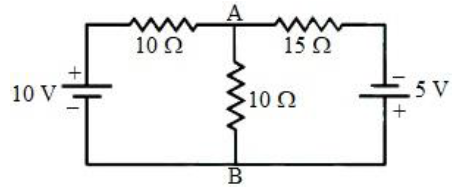
A circuit is as shown in the figure. The current from A to B through the \( 10\,\Omega \) resistor is
Answer & explanation
Correct answer: option 2
The correct answer is Option (2) → +250 mA
By Kirchhoff’s junction rule, the sum of the currents entering junction A equals the sum of the currents leaving it. Taking B as zero potential, each branch current is the potential difference across its resistor divided by the resistance.
From the figure, the bottom wire is at the potential of B:
The 10 V cell has its positive terminal at the top, so the left end of the \( 10\,\Omega \) resistor is at +10 V.
The 5 V cell has its negative terminal at the top, so the right end of the \( 15\,\Omega \) resistor is at −5 V.
Let the potential of A be \( V \) (potentials in volts, resistances in ohms). The currents flowing into A from the two sides add up to the current from A to B:
\( \displaystyle \frac{10-V}{10}+\frac{-5-V}{15}=\frac{V}{10} \)
\( 3\,(10-V)+2\,(-5-V)=3V \)
\( 20-5V=3V \)
\( \Rightarrow\; V=2.5\,\mathrm{V} \)
The current from A to B through the \( 10\,\Omega \) resistor is:
\( \begin{aligned} I_{AB} &= \frac{V_A-V_B}{10\,\Omega} \\ &= \frac{2.5\,\mathrm{V}}{10\,\Omega} \\ &= 0.25\,\mathrm{A} \\ &= 250\,\mathrm{mA} \end{aligned} \)
The positive sign shows that the current flows from A to B.