
CUETMOCK
  • Pricing
  • Mentors
Log inStart freeStart free mocks→

First test, then trust

Try a free CUET mock test.

Join 5,00,000+ students who rehearsed exam day on the exact NTA screen before sitting CUET. On the web and on Android.

Start free mocks →Get the Android app
CUETMOCK

India's #1 CUET Mock Test Platform. Original NCERT-based questions on the exact NTA exam screen — trusted by 5,00,000+ students since CUET 2022.

Get it onGoogle PlayScan to download the CUETMOCK app

Mock tests

  • CUET mock test series
  • Commerce mocks
  • Humanities (Arts) mocks
  • Science mocks
  • Languages & GAT mocks
  • Free practice questions
  • Pricing

Resources

  • CUET exam guide
  • CUET syllabus
  • Universities accepting CUET
  • Expert blogs
  • News & notifications
  • Webinars & counselling
  • CUET score calculator
  • How we estimate your rank
  • FAQs

Company

  • About us
  • Our leadership & team
  • Our toppers
  • Mentors
  • For schools
  • Contact us
  • Terms
  • Privacy
  • Refund policy

Talk to us

+91 7696 6630 56info@cuetmock.comWhatsApp us

Our other platforms

  • JEE Mock — For IIT-JEE aspirants
  • NEET Mock — For NEET aspirants

Newsletter

Exam updates, study material and offers — no spam.

© 2026 NYC Ventures Pvt. Ltd.

701-702, Royal Business Park, Zirakpur, Punjab - 140603

  • Terms of use
  • Privacy policy
  • Refund policy
  • Contact us

iCUETMOCK is an independent preparation platform, not affiliated with the National Testing Agency (NTA). Always check exam details on the official NTA website.

  • Home
  • Mock tests
  • CUET guide
  • Pricing
  • Log in
Home/Practice questions/Chemistry
ChemistryPhysical: Chemical Kinetics

The figure shows the potential energy of a reacting system plotted ag…

The figure shows the potential energy of a reacting system plotted against the reaction coordinate, for the reaction with and without a catalyst.
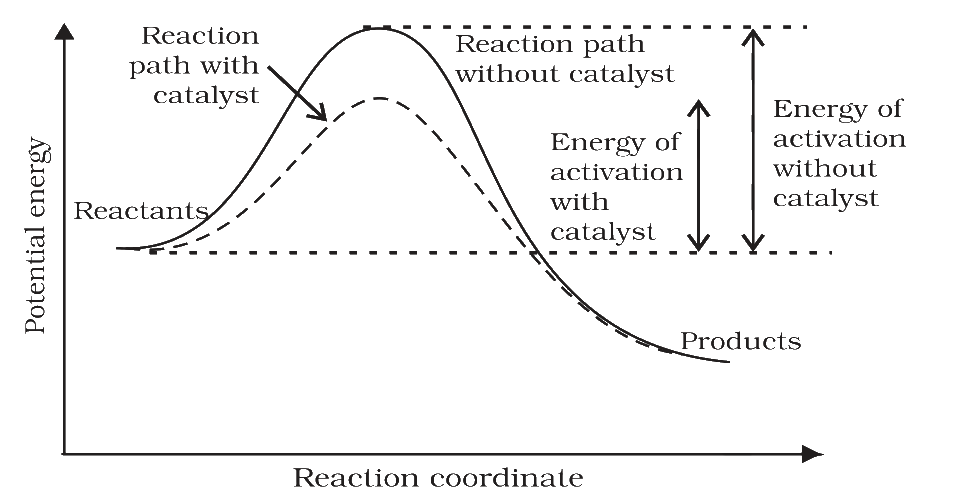
Potential energy against reaction coordinate with and without a catalyst

The activation energy of the reverse reaction (products → reactants) is the energy gap from the products up to the top of the curve. According to the figure, how does the activation energy of the reverse reaction change when the catalyst is used?

Answer & explanation+

Correct answer: option 3

The correct answer is Option (3) → It decreases by the same amount as the activation energy of the forward reaction.

A catalyst gives the reaction an alternate pathway with a lower energy barrier. In the figure the reactants start at the same level and the products end at the same level on both curves; only the top of the hump is lower on the dashed curve.

  • Forward activation energy = top of the hump − energy of the reactants. The top comes down, so it decreases.

  • Reverse activation energy = top of the hump − energy of the products. The products stay where they are and the top comes down by the same amount, so it decreases by that same amount.

This is why a catalyst speeds up the forward and the backward reactions to the same extent; the equilibrium is reached sooner but is not changed.

Why the other options are incorrect

Option (1) It increases by the same amount by which the activation energy of the forward reaction decreases. — Incorrect. A lower hump cannot make the climb from the products taller.

Option (2) It does not change, because the catalyst acts on the forward reaction and not on the reverse reaction. — Incorrect. Both directions pass over the same barrier, so lowering it helps both reactions.

Option (4) It decreases, but by a smaller amount than the activation energy of the forward reaction. — Incorrect. Since the energy of the products does not change, the fall is equal, not smaller.

NCERT (2026-27 edition):
3.4.1 Effect of Catalyst – “It is believed that the catalyst provides an alternate pathway or reaction mechanism by reducing the activation energy between reactants and products and hence lowering the potential energy barrier as shown in Fig. 3.11.”

“…it helps in attaining the equilibrium faster, that is, it catalyses the forward as well as the backward reactions to the same extent so that the equilibrium state remains same but is reached earlier.”

Fig. 3.11

Fig. 3.11: Effect of catalyst on activation energy

Advertisement

Practise more on Physical: Chemical Kinetics

Chapter-wise mocks on the real NTA exam screen, with solutions and your rank. Your first mocks are free.

Start free mocks →

Advertisement

Next questions

  1. Har Gobind Khorana shared the Nobel Prize for Medicine and Physiology in 1968 with Marshall Nirenberg and Robert Holley. For which of the f…Chemistry · Organic: Biomolecules
  2. The acute angle between the lines r = (1-t)(imath+2jmath-k)+t(3imath+3jmath+k) and r = 3k+μ(imath+jmath) isMaths. Section B1 · Three-dimensional Geometry
  3. Match the names linked with the Bengal School era in List-I with what is said about them in List-II.List-IList-IIA. Kala BhavanaI. Its stud…Fine Arts · The Bengal School and Cultural Nationalism
  4. Consider the following statements about Self-Help Groups (SHGs):(A) SHGs promote thrift in small proportions by a minimum contribution from…Economics · Indian Economic Development: Rural Development
  5. Which of the following words does NOT refer to a place where people live?English · Odd One Out
  6. सूची-I के एकवचन शब्दों को सूची-II में दिए गए उनके परसर्ग सहित बहुवचन रूपों से सुमेलित कीजिए :सूची-I (एकवचन)सूची-II (परसर्ग सहित बहुवचन)(A)…Hindi · वचन
  7. The primary coil of a transformer draws a current of 4 A from a 250 V ac supply. The secondary coil gives a current of 2 A at 450 V. The ef…Physics · Alternating Current
  8. Identify the kind of the underlined clause in the following sentence:Dadi often talks about the summer when the well behind her house dried…English · Grammar: Adjective
  9. Which of the following is an egg-laying mammal?General Aptitude Test · General Knowledge
  10. Which of the following ocean currents are cold currents?(A) Benguela Current(B) Kuroshio Current(C) Canary Current(D) California Current(E)…General Aptitude Test · General Knowledge