
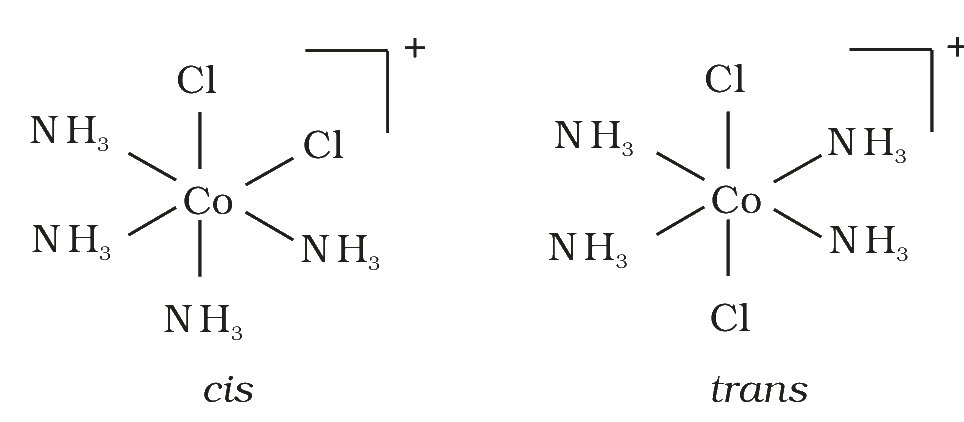
The figure shows the cis and trans isomers of the octahedral complex ion \( \ce{[Co(NH3)4Cl2]^+} \).
What is the Cl–Co–Cl bond angle in the cis isomer and in the trans isomer, respectively?
Answer & explanation
Correct answer: option 2
The correct answer is Option (2) → 90° and 180°
\( \ce{[Co(NH3)4Cl2]^+} \) is an octahedral complex of the type [MX2L4]. In an octahedron, two ligands on adjacent corners make an angle of 90° at the metal, and two ligands on opposite corners make an angle of 180°.
cis isomer — the two Cl ligands are adjacent, so the Cl–Co–Cl angle is 90°.
trans isomer — the two Cl ligands are opposite each other, one above and one below Co, so the Cl–Co–Cl angle is 180°.
NCERT (2026-27 edition):
5.4.1 Geometric Isomerism – “…In a square planar complex of formula [MX2L2] (X and L are unidentate), the two ligands X may be arranged adjacent to each other in a cis isomer, or opposite to each other in a trans isomer… Such isomerism is not possible for a tetrahedral geometry but similar behaviour is possible in octahedral complexes of formula [MX2L4] in which the two ligands X may be oriented cis or trans to each other (Fig. 5.3).”
Fig. 5.3: Geometrical isomers (cis and trans) of [Co(NH3)4Cl2]+