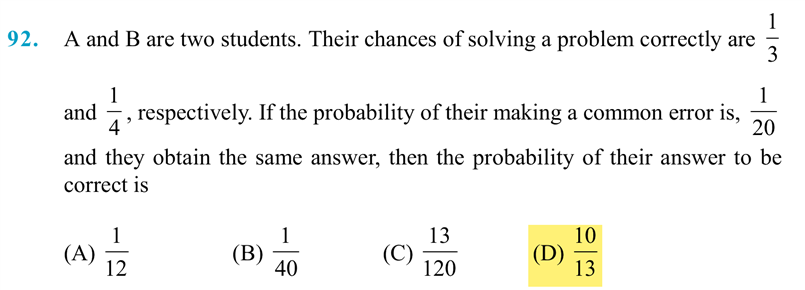
Anita and Bikram are two students. Their chances of solving a problem correctly are \(\displaystyle\frac{1}{3}\) and \(\displaystyle\frac{1}{4}\) respectively. If their probability of making a common error is \(\displaystyle\frac{1}{20}\) and they both obtain same answer then the probability that their answer is correct, is:
Answer & explanation
Correct answer: option 4
The correct answer is Option (4) → \(\displaystyle\frac{10}{13}\)
Let \(E_1\): both solve it correctly, \(E_2\): both go wrong, and A: they obtain the same answer. If only one of them is correct, their answers differ, so that case does not give A.
\( \displaystyle P(E_1) = \frac{1}{3}\times\frac{1}{4} = \frac{1}{12} \)
\( \displaystyle P(E_2) = \frac{2}{3}\times\frac{3}{4} = \frac{1}{2} \)
Two correct answers always agree, so \(P(A|E_1) = 1\). When both go wrong, they get the same answer only if they make the common error, so \(P(A|E_2) = \frac{1}{20}\).
By Bayes’ theorem:
\( \displaystyle P(E_1|A) = \frac{\frac{1}{12}\times 1}{\frac{1}{12}\times 1 + \frac{1}{2}\times\frac{1}{20}} \)
\( \displaystyle = \frac{\frac{1}{12}}{\frac{1}{12} + \frac{1}{40}} = \frac{\frac{10}{120}}{\frac{13}{120}} \)
\( \displaystyle = \frac{10}{13} \)
Why the other options are incorrect
Option (1) \(\displaystyle\frac{1}{12}\) — Incorrect. This is the probability that both are correct before we know that the answers agree; the question asks for it given the same answer.
Option (2) \(\displaystyle\frac{1}{40}\) — Incorrect. This is the probability that both make the same mistake, \(\frac{1}{2}\times\frac{1}{20}\).
Option (3) \(\displaystyle\frac{13}{120}\) — Incorrect. This is P(A), the probability of the same answer, \(\frac{1}{12} + \frac{1}{40}\); it is the denominator, not the answer.
NCERT Exemplar:
Probability