Babur’s memoirs and later records tell us about Mughal artists. Consider the following statements:
(A) Bihzad is among the artists who find mention in Babur’s memoirs.
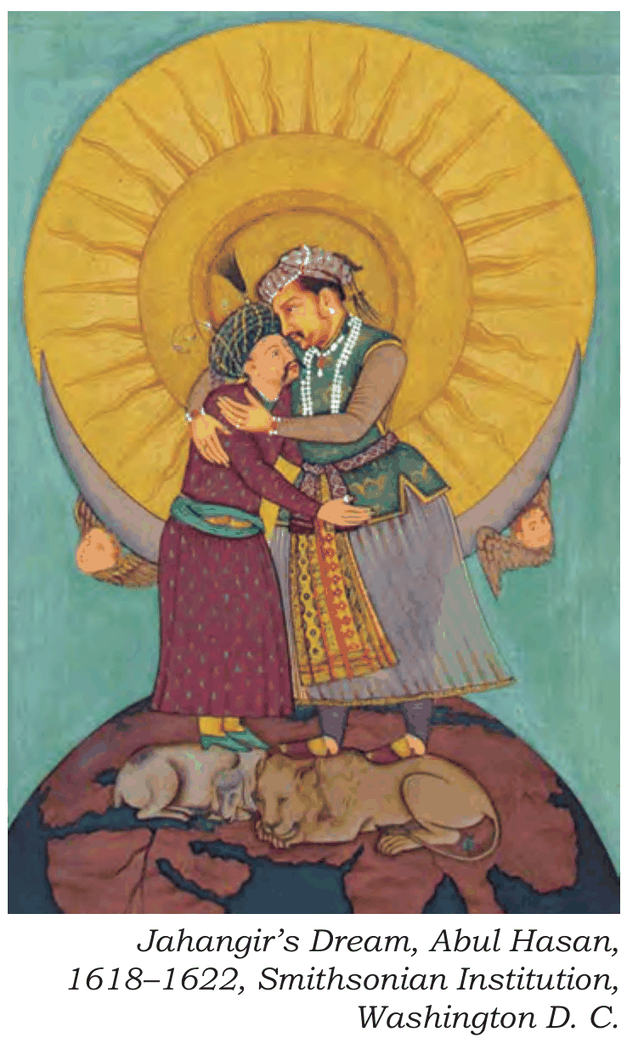
(B) Jahangir’s Dream was painted by Abul Hasan.
(C) Babur thought Shah Muzaffar excelled in the representation of faces.
(D) In workshops, draft drawing, grinding and colouring were usually distributed among a group of artists.
Choose the correct answer from the options given below:
Answer & explanation
Correct answer: option 1
The correct answer is Option (1) → (A), (B) and (D) only
(A) Bihzad is among the artists who find mention in Babur’s memoirs. — Correct. Babur names Bihzad, a master artist of the Persian school of Herat.
(B) Jahangir’s Dream was painted by Abul Hasan. — Correct. The caption under the painting names Abul Hasan as its painter.
(C) Babur thought Shah Muzaffar excelled in the representation of faces. — Incorrect. Babur praised Shah Muzaffar for the representation of hairstyle. His remark on faces was about Bihzad, who he felt did not draw them well.
(D) In workshops, draft drawing, grinding and colouring were usually distributed among a group of artists. — Correct. Painting in the workshops was a combined effort of a group of artists, with these tasks shared out.
NCERT (2026-27): “Early Mughal Painting …Babur had a keen eye for portraiture and this is also recorded in his memoirs. Among the artists, who find mention in Babur’s memoirs is Bihzad. Bihzad’s work was dainty but he did not draw the faces well; he used to greatly lengthen the double chin (ghab-ghab); and drew bearded faces admirably. Bihzad was a master artist from the Persian school of painting, Herat (now in present day Afghanistan), and was known for his sophisticated compositions and colour tints. Also, Shah Muzaffar finds a mention as a painter, who Babur thought excelled in the representation of hairstyle.…” “Colours and Technique of Mughal Painting …In workshops, painting was a combined effort of a group of artists, among whom basic draft drawing, grinding and filling in of colours, and adding details were, usually, distributed. However, they may also have been produced single handedly.…”
|