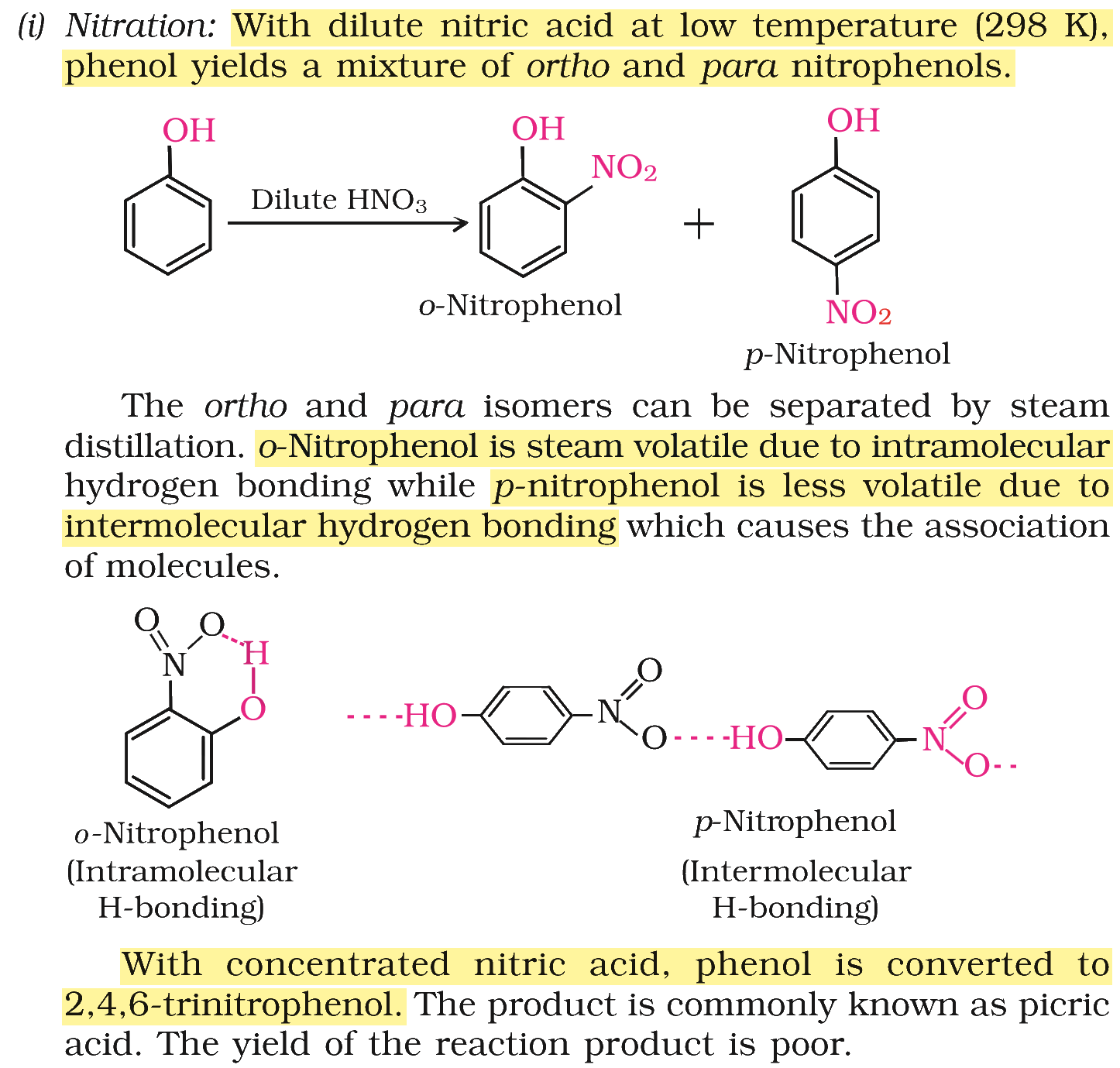
Which one of the following statements is incorrect regarding the nitration of phenol with nitric acid?
Answer & explanation
Correct answer: option 3
The correct answer is Option (3) → o-Nitrophenol is steam volatile due to intermolecular hydrogen bonding.
The –OH group strongly activates the benzene ring, so phenol is nitrated even by dilute nitric acid at 298 K. This gives a mixture of o-nitrophenol and p-nitrophenol, which are separated by steam distillation:
\( \displaystyle \ce{C6H5OH} \xrightarrow[\text{298 K}]{\text{dil. }\ce{HNO3}} \text{o-nitrophenol} + \text{p-nitrophenol} \)
Statement (3) gives the right fact with the wrong reason: o-nitrophenol is steam volatile because of intramolecular, not intermolecular, hydrogen bonding.
Option (1) Nitration with dilute nitric acid at 298 K gives a mixture of two isomers (o-nitrophenol and p-nitrophenol) that can be separated by steam distillation. — A correct statement about nitration of phenol. The ortho isomer distils with steam and the para isomer stays behind.
Option (2) p-Nitrophenol is less volatile due to intermolecular hydrogen bonding. — A correct statement about nitration of phenol. Its –OH and –NO2 groups are too far apart to bond within the molecule, so the molecules associate, which raises the boiling point.
Option (3) o-Nitrophenol is steam volatile due to intermolecular hydrogen bonding. — The incorrect statement. The neighbouring –OH and –NO2 groups form an intramolecular hydrogen bond, so the molecules do not associate.
Option (4) Nitration with concentrated nitric acid gives 2,4,6-trinitrophenol. — A correct statement about nitration of phenol. Concentrated \( \ce{HNO3} \) nitrates all three activated positions, giving picric acid: \( \ce{C6H5OH + 3HNO3 -> C6H2(NO2)3OH + 3H2O} \)
NCERT (2026-27 edition):
Nitration