
CUETMOCK
  • Pricing
  • Mentors
Log inStart freeStart free mocks→

First test, then trust

Try a free CUET mock test.

Join 5,00,000+ students who rehearsed exam day on the exact NTA screen before sitting CUET. On the web and on Android.

Start free mocks →Get the Android app
CUETMOCK

India's #1 CUET Mock Test Platform. Original NCERT-based questions on the exact NTA exam screen — trusted by 5,00,000+ students since CUET 2022.

Get it onGoogle PlayScan to download the CUETMOCK app

Mock tests

  • CUET mock test series
  • Commerce mocks
  • Humanities (Arts) mocks
  • Science mocks
  • Languages & GAT mocks
  • Free practice questions
  • Pricing

Resources

  • CUET exam guide
  • CUET syllabus
  • Universities accepting CUET
  • Expert blogs
  • News & notifications
  • Webinars & counselling
  • CUET score calculator
  • How we estimate your rank
  • FAQs

Company

  • About us
  • Our leadership & team
  • Our toppers
  • Mentors
  • For schools
  • Contact us
  • Terms
  • Privacy
  • Refund policy

Talk to us

+91 7696 6630 56info@cuetmock.comWhatsApp us

Our other platforms

  • JEE Mock — For IIT-JEE aspirants
  • NEET Mock — For NEET aspirants

Newsletter

Exam updates, study material and offers — no spam.

© 2026 NYC Ventures Pvt. Ltd.

701-702, Royal Business Park, Zirakpur, Punjab - 140603

  • Terms of use
  • Privacy policy
  • Refund policy
  • Contact us

iCUETMOCK is an independent preparation platform, not affiliated with the National Testing Agency (NTA). Always check exam details on the official NTA website.

  • Home
  • Mock tests
  • CUET guide
  • Pricing
  • Log in
Home/Practice questions/Physics
PhysicsDual Nature of Radiation and Matter

Light of the same frequency but of intensities I_1 , I_2 and I_3 (I_1…

Read the following passage and answer the questions.

The figure shows the set-up a student uses to study the photoelectric effect. An evacuated glass tube holds a photosensitive plate C (the emitter) and a metal plate A (the collector). Light from a source S enters through a quartz window and falls on plate C. A battery keeps a potential difference between C and A, and she can change its value. A commutator reverses the polarity, so plate A can be made positive or negative with respect to C. A voltmeter reads this potential difference, and a microammeter reads the photocurrent.

She chooses the frequency of the light by placing coloured filters in its path. She changes the intensity by moving the source nearer to or farther from plate C. For each setting, she records the microammeter reading as the potential of A is changed from a large positive value to negative values.
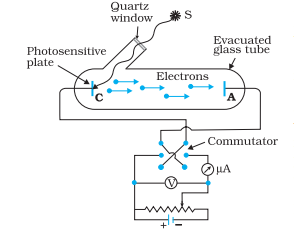
Figure for the question

Light of the same frequency but of intensities \( I_1 \), \( I_2 \) and \( I_3 \) \( (I_1>I_2>I_3) \) falls in turn on the plate C. What can we say about the stopping potentials \( V_1 \), \( V_2 \) and \( V_3 \)?

Answer & explanation+

Correct answer: option 3

The correct answer is Option (3) → \( V_1=V_2=V_3 \)

The stopping potential measures the maximum kinetic energy of the photoelectrons, \( eV_0=K_{\mathrm{max}} \), and by Einstein’s photoelectric equation \( K_{\mathrm{max}}=h\nu-\phi_0 \). The intensity does not appear in either relation.

Option (1) \( V_1\lt V_2\lt V_3 \) — Incorrect. This would make the stopping potential fall as the light gets brighter. But the energy of each photon, and so \( K_{\mathrm{max}} \), does not change with intensity.

Option (2) \( V_1\gt V_2\gt V_3 \) — Incorrect. Brighter light ejects more electrons per second. This raises the saturation current. The maximum kinetic energy of each electron stays the same.

Option (3) \( V_1=V_2=V_3 \) — Correct. The frequency is the same, so every photon has the same energy \( h\nu \). The fastest photoelectrons from plate C have the same \( K_{\mathrm{max}} \) in all three cases. Hence the stopping potential does not depend on intensity.

Option (4) cannot say — Incorrect. The frequency and the plate material are the same in all three cases, and these two fix \( K_{\mathrm{max}} \) and hence \( V_0 \).

NCERT (2026-27):
Effect of Potential on Photoelectric Current – “… We can now repeat this experiment with incident radiation of the same frequency but of higher intensity I2 and I3 (I3 > I2 > I1). We note that the saturation currents are now found to be at higher values. This shows that more electrons are being emitted per second, proportional to the intensity of incident radiation. … Thus, for a given frequency of the incident radiation, the stopping potential is independent of its intensity.”

Advertisement

Practise more on Dual Nature of Radiation and Matter

Chapter-wise mocks on the real NTA exam screen, with solutions and your rank. Your first mocks are free.

Start free mocks →

Advertisement

Next questions

  1. Chemistry · Inorganic: D and F Block Elements
  2. In the Appiko movement in Karnataka, how did the people prevent the felling of trees?Economics · Indian Economic Development: Environment and Sustainable Development
  3. Who was often addressed as the father of Indian Archaeology?History · Ancient India: Bricks, Beads and Bones
  4. Which of the following report resulted in the crash of Adani group shares in Jan-Feb 2023?General Aptitude Test · Current Affairs
  5. What new trend was witnessed in the 2014 and 2019 Lok Sabha elections?1) Emergence of a socialist party2) A two-party political system3) Se…Political Science · Politics in India Since Independence: Recent Developments in Indian Politics
  6. Which option provides the most accurate definition of health?Biology · Human Health and Disease
  7. In the following question, out of the given four alternatives, select the alternative which best expresses the meaning of the Idiom/Phrase.…English · Grammar: Idioms
  8. Which of the following is not necessary for the preparation of recombinant DNA molecules?Biology · Biotechnology -Principles and Processes
  9. Which treaty was signed by the US, UK and USSR in Moscow on 5th August 1963, to ban nuclear weapon tests in Atmosphere, in outer space and…Political Science · Contemporary World Politics: The Cold War Era
  10. There are two statements marked as Assertion (A) and Reason (R). Mark your answer as per the options given below. Assertion (A): Shares can…Accountancy Part A · Accounting for Shares