
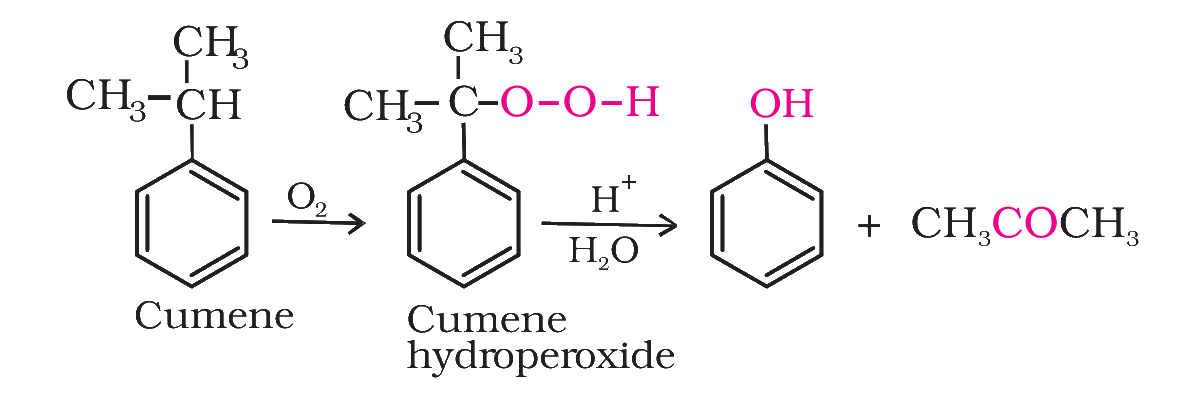
The scheme shows the manufacture of phenol from cumene.
What happens to cumene in the first step of the scheme?
Answer & explanation
Correct answer: option 1
The correct answer is Option (1) → It is oxidised by air, and an –O–O–H group is attached to the side-chain carbon that carried a hydrogen atom.
The reagent of the first step is O2, the oxygen of air, so cumene is oxidised.
In cumene (isopropylbenzene) the side-chain carbon joined to the ring carries one H atom; in the product, cumene hydroperoxide, the same carbon carries an –O–O–H group in its place.
The second step, with dilute acid (H+/H2O), splits cumene hydroperoxide into phenol and acetone.
\( \displaystyle \ce{C6H5CH(CH3)2} \xrightarrow{\ce{O2}\text{ (air)}} \ce{C6H5C(CH3)2OOH} \xrightarrow{\ce{H+}/\ce{H2O}} \ce{C6H5OH + CH3COCH3} \)
Why the other options are incorrect
Option (2) It is oxidised by air, and an –OH group is attached directly to a carbon atom of the benzene ring. — Incorrect. The reagent is right, but after step 1 the ring is unchanged; the new group, –O–O–H, is on the side chain. The ring –OH appears only in phenol, after step 2.
Option (3) It is hydrolysed by water, and an –O–O–H group is attached to the side-chain carbon that carried a hydrogen atom. — Incorrect. The reagent of step 1 is O2, not water; water and acid are used only in step 2.
Option (4) It is hydrolysed by water, and an –OH group is attached directly to a carbon atom of the benzene ring. — Incorrect. Step 1 is an oxidation by O2, and it gives cumene hydroperoxide, not a ring –OH compound.
NCERT (2026-27 edition):
7.4.2 Preparation of Phenols – “Phenol is manufactured from the hydrocarbon, cumene. Cumene (isopropylbenzene) is oxidised in the presence of air to cumene hydroperoxide. It is converted to phenol and acetone by treating it with dilute acid.”
Preparation of phenol from cumene (7.4.2)