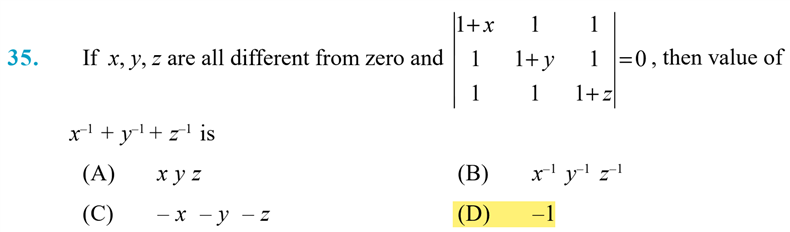
If a, b and c are all different from zero and \(\begin{vmatrix}1+a & 1 & 1 \\ 1 & 1+b & 1 \\ 1 & 1 & 1+c\end{vmatrix}=0\), then the value of \(\displaystyle\frac{1}{a}+\frac{1}{b}+\frac{1}{c}\) is:
Answer & explanation
Correct answer: option 3
The correct answer is Option (3) → −1
Expanding the determinant along the first row:
\( (1+a)\big[(1+b)(1+c) - 1\big] - 1\big[(1+c) - 1\big] + 1\big[1 - (1+b)\big] \)
\(= (1+a)(b + c + bc) - c - b\)
\(= ab + bc + ca + abc\)
Setting it equal to 0 and dividing by \(abc\) (which is not 0):
\( \displaystyle \frac{1}{c} + \frac{1}{a} + \frac{1}{b} + 1 = 0 \)
\( \displaystyle \frac{1}{a} + \frac{1}{b} + \frac{1}{c} = -1 \)
NCERT Exemplar:
Determinants