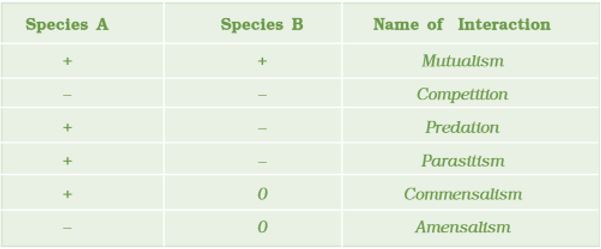
Match List-I with List-II
| List-I | List-II |
| Signs of Interspecific Interactions (Between Species A and B) | Population Interactions |
| (A). +/- | (I). Commensalism |
| (B). +/+ | (II). Parasitism |
| (C). +/0 | (III). Amensalism |
| (D). -/0 | (IV). Mutualism |
'+sign for beneficial interaction, '-' sign for detrimental interaction and '0' for neutral interaction.
Choose the correct answer from the options given below:
Answer & explanation
Correct answer: option 1
The correct answer is Option (1) → (A)- (II), (B)- (IV), (C)- (I), (D)- (III)
| List-I | List-II |
| Signs of Interspecific Interactions (Between Species A and B) | Population Interactions |
| (A). +/- | (II). Parasitism |
| (B). +/+ | (IV). Mutualism |
| (C). +/0 | (I). Commensalism |
| (D). -/0 | (III). Amensalism |
A. Parasitism is generally defined as a relationship between the two living species in which one organism is benefitted at the expense of the other. The organism that is benefitted is called the parasite, while the one that is harmed is called the host. Endoparasites are those that live inside the host body at different sites (liver, kidney, lungs, red blood cells, etc.)
B. Mutualism: This interaction confers benefits on both the interacting species. Lichens represent an intimate mutualistic relationship between a fungus and photosynthesising algae or cyanobacteria. Similarly, the mycorrhizae are associations between fungi and the roots of higher plants. The fungi help the plant in the absorption of essential nutrients from the soil while the plant in turn provides the fungi with energy-yielding carbohydrates.
C. Commensalism: This is the interaction in which one species benefits and the other is neither harmed nor benefited. An orchid growing as an epiphyte on a mango branch, and barnacles growing on the back of a whale benefit while neither the mango tree nor the whale derives any apparent benefit. The cattle egret and grazing cattle in close association, a sight you are most likely to catch if you live in farmed rural areas, is a classic example of commensalism.
D. In amensalism, one species is harmed whereas the other is unaffected.