Read the passage and answer the question:
“The British element is gone, but they have left the mischief behind” :
Sardar Vallabh Bhai Patel said :
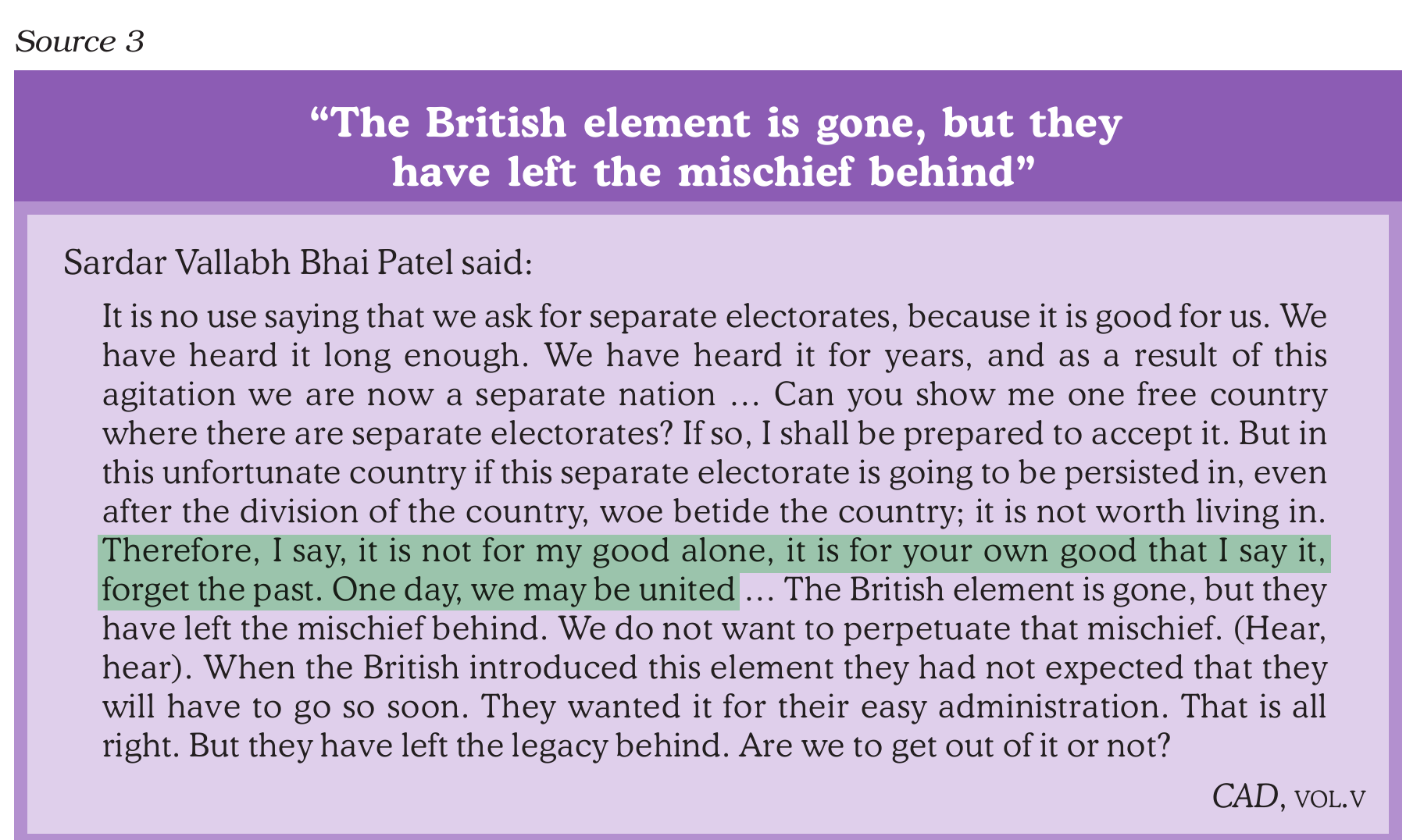
It is no use saying that we ask for separate electorates, because it is good for us. We have heard it long enough. We have heard it for years, and as a result of this agitation, we are now a separate nation... Can you show me one free country where there are separate electorates? If so, I shall be prepared to accept it. But in this unfortunate country if this separate electorate is going to be persisted in, even after the division of the country, woe betide the country; it is not worth living in. Therefore, I say, it is not for my good alone, it is for your own good that I say it, forget the past. One day, we may be united ... The British element is gone, but they have left the mischief behind. We do not want to perpetuate that mischief. (Hear, hear). When the British introduced this element they had not expected that they will have to go so soon. They wanted it for their easy administration. That is all right. But they have left the legacy behind. Are we to get out of it or not?
Which one of the following fact is NOT correct about Vallabhbhai Patel?
Answer & explanation
Correct answer: option 4
The correct answer is Option (4) → He wanted minorities should leave the country.
The passage talks about Patel’s plea to give up separate electorates. He asks the members to “forget the past” and hopes that one day “we may be united”; he says it is “for your own good”, that is, for the good of the minorities too. Nowhere does he want the minorities to leave the country. The other three statements are true of Patel: he was one of the dominant voices of the Constituent Assembly, he worked mostly behind the scenes, playing a key role in the drafting of several reports, and he was against separate electorates.
Hence, the answer is He wanted minorities should leave the country.
NCERT (2026-27): “1.2 The dominant voices … The Constituent Assembly had 300 members. Of these, six members played particularly important roles. Three were representatives of the Congress, namely, Jawaharlal Nehru, Vallabh Bhai Patel and Rajendra Prasad. It was Nehru who moved the crucial ‘Objectives Resolution’, as well as the resolution proposing that the National Flag of India be a ‘horizontal tricolour of saffron, white and dark green in equal proportion’, with a wheel in navy blue at the centre. Patel, on the other hand, worked mostly behind the scenes, playing a key role in the drafting of several reports, and working to reconcile opposing points of view.… 3.1 The problem with separate electorates … Partition had made nationalists fervently opposed to the idea of separate electorates. They were haunted by the fear of continued civil war, riots and violence. Separate electorates was a ‘poison that has entered the body politic of our country’, declared Sardar Patel. It was a demand that had turned one community against another, divided the nation, caused bloodshed, and led to the tragic partition of the country. ‘Do you want peace in this land? If so do away with it (separate electorates),’ urged Patel.”
|