
In the network shown in the figure potentials at points A, B, C and D are 5 V, 10 V, 20 V and 30 V respectively and the resistance \( R_1, R_2, R_3 \) and \( R_4 \) are \( 5\,\Omega \), \( 10\,\Omega \), \( 20\,\Omega \) and \( 40\,\Omega \) respectively.
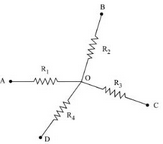
What is the current in the resistance \( R_1 \)?
Answer & explanation
Correct answer: option 2
The correct answer is Option (2) → 1 A away from O
The four resistors meet at the junction O. By Kirchhoff’s junction rule, the currents flowing into O from A, B, C and D add up to zero. Let \( V_O \) be the potential of O; the current from each point towards O is \( (V - V_O)/R \).
\( \displaystyle \frac{5 - V_O}{5} + \frac{10 - V_O}{10} + \frac{20 - V_O}{20} + \frac{30 - V_O}{40} = 0 \)
Multiplying by 40:
\( 8(5 - V_O) + 4(10 - V_O) + 2(20 - V_O) + (30 - V_O) = 0 \)
\( 150 - 15V_O = 0 \Rightarrow V_O = 10\,\mathrm{V} \)
Current in \( R_1 \), from A towards O:
\( \displaystyle I_1 = \frac{5 - 10}{5} = -1\,\mathrm{A} \)
The negative sign means the current flows the other way: 1 A from O to A, that is, away from O, since O (10 V) is at the higher potential.