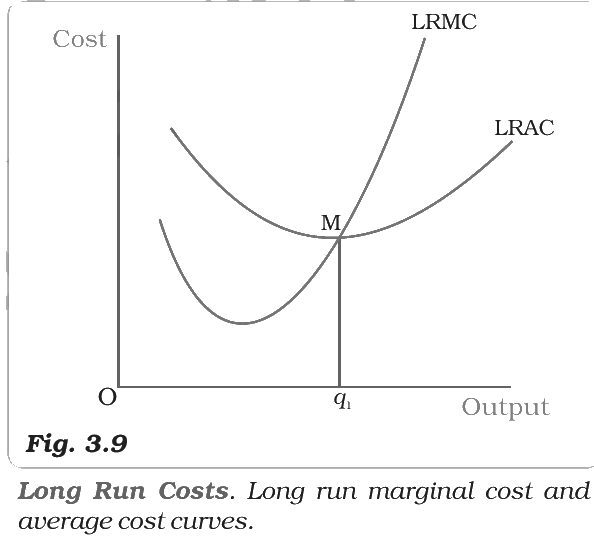
Study the given figure. The portion of LRAC curve highlighted by blue colour in the graph explains which concept?
Answer & explanation
Correct answer: option 2
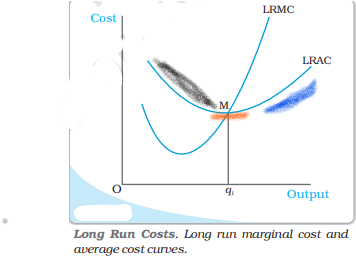
The correct answer is Option (2) → Decreasing returns to Scale
The marked part is where the LRAC curve rises. Average cost rises as output grows only under decreasing returns to scale.
Under DRS, output rises by a smaller proportion than the inputs, so cost rises faster than output.
NCERT (2026-27): “Shapes of the Long Run Cost Curves … DRS implies that if we want to increase the output by a certain proportion, inputs need to be increased by more than that proportion. As a result, cost also increases by more than that proportion. So, as long as DRS operates, the average cost must be rising as the firm increases output. CRS implies a proportional increase in inputs resulting in a proportional increase in output. So the average cost remains constant as long as CRS operates. It is argued that in a typical firm IRS is observed at the initial level of production. This is then followed by the CRS and then by the DRS. Accordingly, the LRAC curve is a ‘U’-shaped curve. Its downward sloping part corresponds to IRS and upward rising part corresponds to DRS. At the minimum point of the LRAC curve, CRS is observed.”
|