
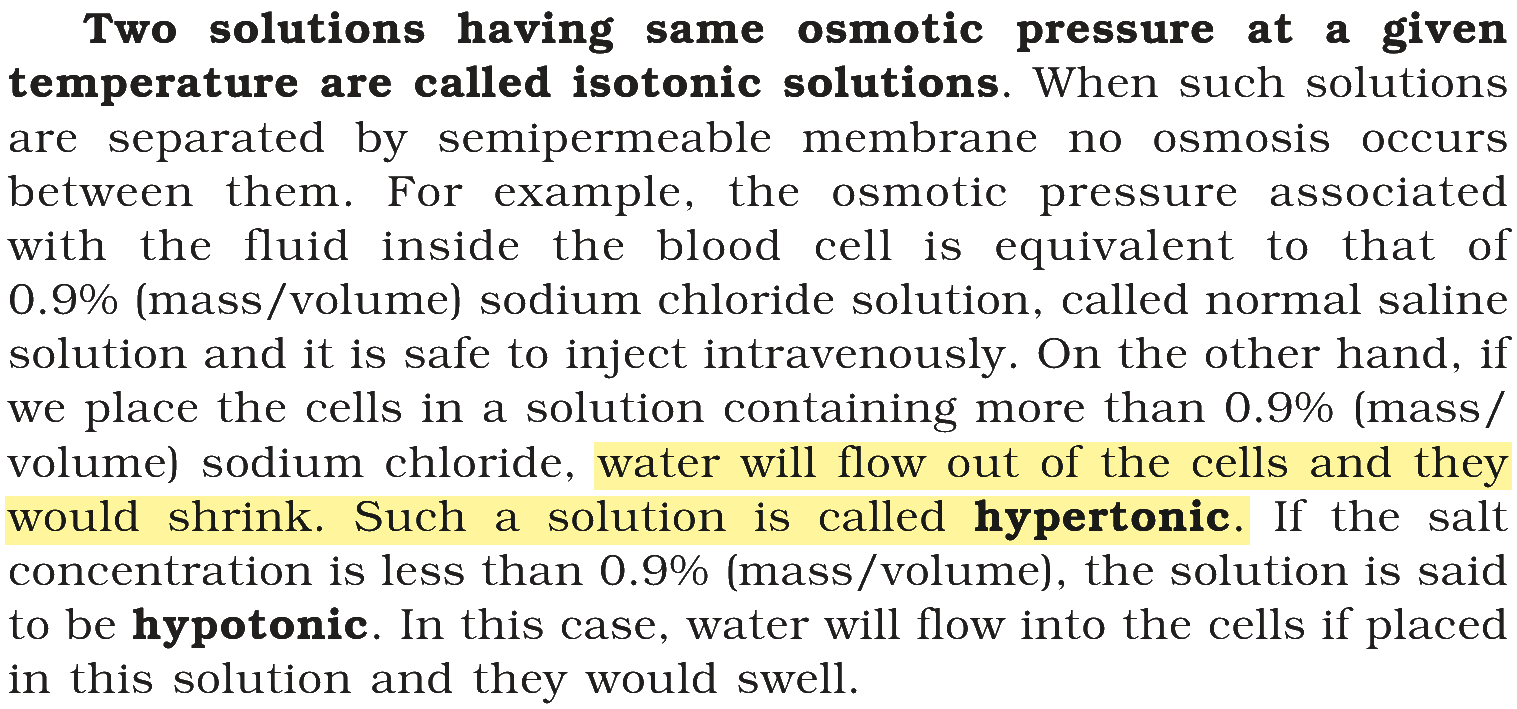
If you place blood cells in a solution containing more than 0.9% (mass/volume) sodium chloride, water will flow out of the cells and they will shrink. Such a solution is called
Answer & explanation
Correct answer: option 2
The correct answer is Option (2) → Hypertonic
Water moves by osmosis from the solution of lower concentration to the one of higher concentration across the cell membrane. The fluid inside a red blood cell has the same osmotic pressure as a 0.9% (mass/volume) NaCl solution (normal saline),. A solution with more NaCl than this draws water out of the cells.
A solution with more than 0.9% NaCl, which makes the cells lose water and shrink, is hypertonic.
Why the other options are incorrect
Option (1) Hypotonic — Incorrect. A hypotonic solution is more dilute than the cell fluid; water would flow into the cells and they would swell.
Option (3) Saturated — Incorrect. A saturated solution holds the maximum amount of solute that can dissolve at that temperature; the term has nothing to do with comparing osmotic pressures.
Option (4) Isotonic — Incorrect. An isotonic solution (0.9% NaCl) has the same osmotic pressure as the cell fluid, so there is no net flow of water.
NCERT (2026-27 edition):
Osmosis and Osmotic Pressure – …
Note: The same/similar question has been asked in different years by NTA as per the details given below:
| 2026 | 2025 | 2024 | 2023 | 2022 |
|---|---|---|---|---|
| – | 22-05 S1 15-05 S2 | – | – | – |