Which of the following statement/statements are true?
Statement I: When increase in demand is more than increase in supply, equilibrium price remains unchanged.
Statement II: When increase in demand is more than increase in supply, rightward shift in demand will be more than leftward shift in supply.
Answer & explanation
Correct answer: option 2
The correct answer is Option (2) → Both the statements are false.
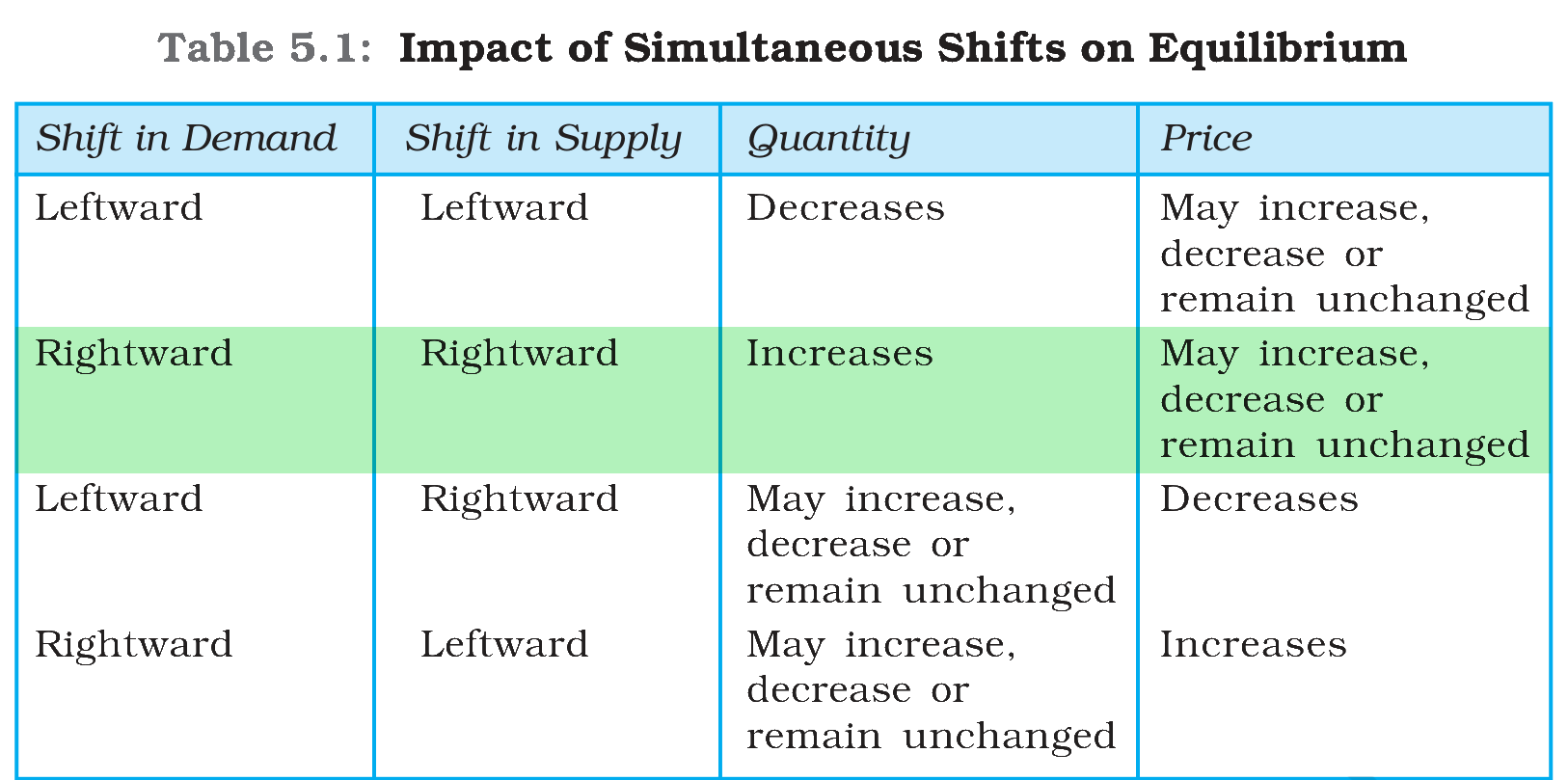
When demand and supply both shift right, the quantity always rises. The price moves the way of the bigger shift; here demand rises more, so the price rises.
Statement I: When increase in demand is more than increase in supply, equilibrium price remains unchanged. — False. Demand rises more, so at the old price there is excess demand. The price rises.
Statement II: When increase in demand is more than increase in supply, rightward shift in demand will be more than leftward shift in supply. — False. An increase in supply moves the supply curve to the right, not to the left.
Note: NTA uses the terms ‘increase in demand’ and ‘increase in supply’; NCERT describes these as rightward shifts of the demand curve and the supply curve.
NCERT (2026-27): “Simultaneous Shifts of Demand and Supply … In the first two cases which are shown in the first two rows of the table, the impact on equilibrium quantity is unambiguous but the equilibrium price may change, if at all, in either direction depending on the magnitudes of shifts. In the next two cases, shown in the last two rows of the table, the effect on price is unambiguous whereas effect on quantity depends on the magnitude of shifts in the two curves.”
|