


CUET Preparation Today
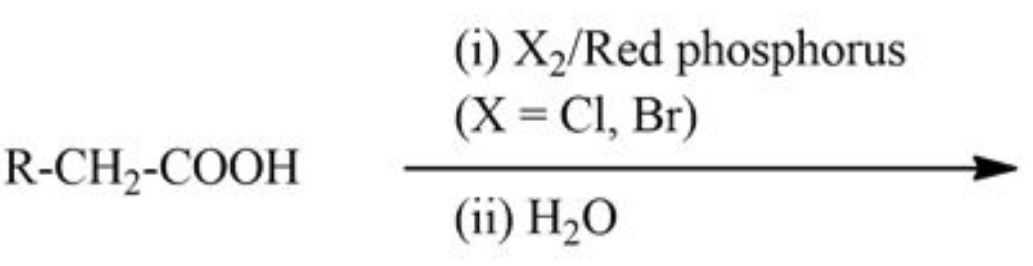
What is the product of the following reaction?
|
$α$-Halocarboxylic acid $β$-Halocarboxylic acid $α,β$-Dihalocarboxylic acid 1,1-Dihalocarboxylic acid |
$α$-Halocarboxylic acid |
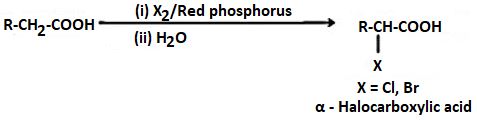
The correct answer is Option (1) → $α$-Halocarboxylic acid The given reaction uses halogen (Cl₂ or Br₂) in the presence of red phosphorus followed by hydrolysis with water. This set of reagents corresponds to the Hell–Volhard–Zelinsky (HVZ) reaction. The HVZ reaction is a well-known reaction in organic chemistry used for α-halogenation of carboxylic acids that contain at least one α-hydrogen. General reaction: R–CH₂–COOH → R–CHX–COOH (X = Cl or Br) Steps involved: 1. Formation of acyl halide Red phosphorus reacts with halogen to form PX₃, which converts the carboxylic acid into an acid halide (R–CH₂–COX). 2. α-Halogenation The acid halide undergoes enol formation, and the halogen substitutes the α-hydrogen to produce R–CHX–COX. 3. Hydrolysis When treated with water, the acid halide converts back into the carboxylic acid, giving α-halocarboxylic acid. Final product: R–CHX–COOH Thus, halogen substitution occurs specifically at the α-carbon (carbon adjacent to the carboxyl group).
Option-wise Explanation Option 1: α-Halocarboxylic acid In the HVZ reaction, halogen substitution occurs at the α-position of the carboxylic acid due to enol formation and electrophilic halogenation. After hydrolysis, the product becomes R–CHX–COOH, which is an α-halocarboxylic acid. Therefore, this option is correct. Option 2: β-Halocarboxylic acid β-Halogenation would involve substitution at the second carbon away from the carboxyl group. The HVZ reaction specifically halogenates the α-carbon, not the β-carbon. Hence this option is incorrect. Option 3: α, β-Dihalocarboxylic acid The reaction introduces only one halogen atom at the α-position. It does not produce halogen substitution at both α and β positions. Therefore this option is incorrect. Option 4: 1,1-Dihalocarboxylic acid This structure would require two halogens attached to the same carbon atom. The HVZ reaction introduces only one halogen atom at the α-carbon, so this option is incorrect. |