


CUET Preparation Today
If $y = x(x - 3)^2$ decreases for the values of $x$ given by |
$1 < x < 3$ $x < 0$ $x > 0$ $0 < x < \frac{3}{2}$ |
$1 < x < 3$ |
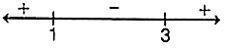
The correct answer is Option (1) → $1 < x < 3$ ## We have, $y = x(x - 3)^2$ $∴\frac{dy}{dx} = x \cdot 2(x - 3) \cdot 1 + (x - 3)^2 \cdot 1$ $= 2x^2 - 6x + x^2 + 9 - 6x = 3x^2 - 12x + 9$ $= 3(x^2 - 3x - x + 3) = 3(x - 3)(x - 1)$
So, $y = x(x - 3)^2$ decreases for $(1, 3)$. $[\text{since, } y' < 0 \text{ for all } x \in (1, 3), \text{ hence } y \text{ is decreasing on } (1, 3)]$ |