
CUETMOCK
  • Pricing
  • Mentors
Log inStart freeStart free mocks→

First test, then trust

Try a free CUET mock test.

Join 5,00,000+ students who rehearsed exam day on the exact NTA screen before sitting CUET. On the web and on Android.

Start free mocks →Get the Android app
CUETMOCK

India's #1 CUET Mock Test Platform. Original NCERT-based questions on the exact NTA exam screen — trusted by 5,00,000+ students since CUET 2022.

Get it onGoogle PlayScan to download the CUETMOCK app

Mock tests

  • CUET mock test series
  • Browse all papers
  • Commerce mocks
  • Humanities (Arts) mocks
  • Science mocks
  • Languages & GAT mocks
  • Free practice questions
  • Pricing

Resources

  • CUET exam guide
  • CUET syllabus
  • Universities accepting CUET
  • Expert blogs
  • News & notifications
  • Webinars & counselling
  • CUET score calculator
  • How we estimate your rank
  • FAQs

Company

  • About us
  • Our leadership & team
  • Our toppers
  • Mentors
  • For schools
  • Contact us
  • Terms
  • Privacy
  • Refund policy

Talk to us

+91 7696 6630 56info@cuetmock.comWhatsApp us

Our other platforms

  • JEE Mock — For IIT-JEE aspirants
  • NEET Mock — For NEET aspirants

Newsletter

Exam updates, study material and offers — no spam.

© 2026 NYC Ventures Pvt. Ltd.

701-702, Royal Business Park, Zirakpur, Punjab - 140603

  • Terms of use
  • Privacy policy
  • Refund policy
  • Contact us

iCUETMOCK is an independent preparation platform, not affiliated with the National Testing Agency (NTA). Always check exam details on the official NTA website.

  • Home
  • Mock tests
  • CUET guide
  • Pricing
  • Log in
Home/Practice questions/Mathematics
MathematicsSets

Which of the following is correct?

Which of the following is correct?

Answer & explanation+

Correct answer: option 3

The correct answer is Option (3) → $n (A ∪ B) = n (A) + n (B) – n (A ∩ B)$

In the Venn diagram,
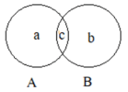
$n (A ∪ B) = a + b + c$

$n(A) = a + c, n(B) = b + c$ and $n (A ∩ B) = c$

$n (A) + n (B) – n (A ∩ B) = (a + c) + (b + c)-c = a + b + c$

Hence, $n (A ∪ B) = n (A) + n (B) – n (A ∩ B)$.

Advertisement

Practise more on Sets

Chapter-wise mocks on the real NTA exam screen, with solutions and your rank. Your first mocks are free.

Start free mocks →

Advertisement

Next questions

  1. What is the main reason for greater number of oxidation states of actinoids than of lanthanides?Chemistry · Inorganic: D and F Block Elements
  2. Chemistry · Inorganic: D and F Block Elements
  3. With reference to the Rorschach Inkblot Test identify the correct sequence in which test is administered A. In performance proper phase sub…Psychology · Self and Personality
  4. Arrange the following modern Indian languages on the basis of number of speakers in descending order. (A) Dravidian(B) Indo-European(C) Sin…Geography · India-People and Economy: Population-Distribution,Density, Growth and Composition
  5. Match List I with List II.List IList II(Site)(River)A.HarappaI.IndusB.Mohenjo-daroII.RaviC.LothalIII.GhaggarD.BanawaliIV.BhogavaChoose the…General Aptitude Test · General Knowledge
  6. Read the given statements and conclusions carefully. Assuming that the information given in the statements is true, even if it appears to b…General Aptitude Test · Verbal Reasoning
  7. The term "Zimmi" was used for followers of which of the following religions during the rule of Muslims in India?History · Medieval India: Bhakti Sufi Traditions
  8. निम्नलिखित में किन वाक्यों में सकर्मक क्रिया नहीं है? A. अनु जाता हैB. अनुज विद्यालय जाता हैC. ज्योति हँसती हैD. कविता बाग में खेल रही हैE.…Hindi · व्याकरण - क्रिया
  9. Deccani paintings are known for their visual features. Which of the following pairs is correctly matched?Fine Arts · The Deccani Schools of Painting
  10. Which of the following statements about a parameter and a statistic is NOT correct?Applied Maths. Section B2 · Inferential Statistics