Answer the question on the basis of passage given below:
For the Transition Elements.
|
|
Sc |
Ti |
V |
Cr |
Mn |
Fe |
Co |
Ni |
Cu |
Zn |
|
Atomic Number: |
21 |
22 |
23 |
24 |
25 |
26 |
27 |
28 |
29 |
30 |
Which transition element has the largest enthalpy of atomization \(\Delta_a H^\circ \, kJ\, mol^{-1}\)?
Answer & explanation
Correct answer: option 1
The correct answer is Option (1) → V
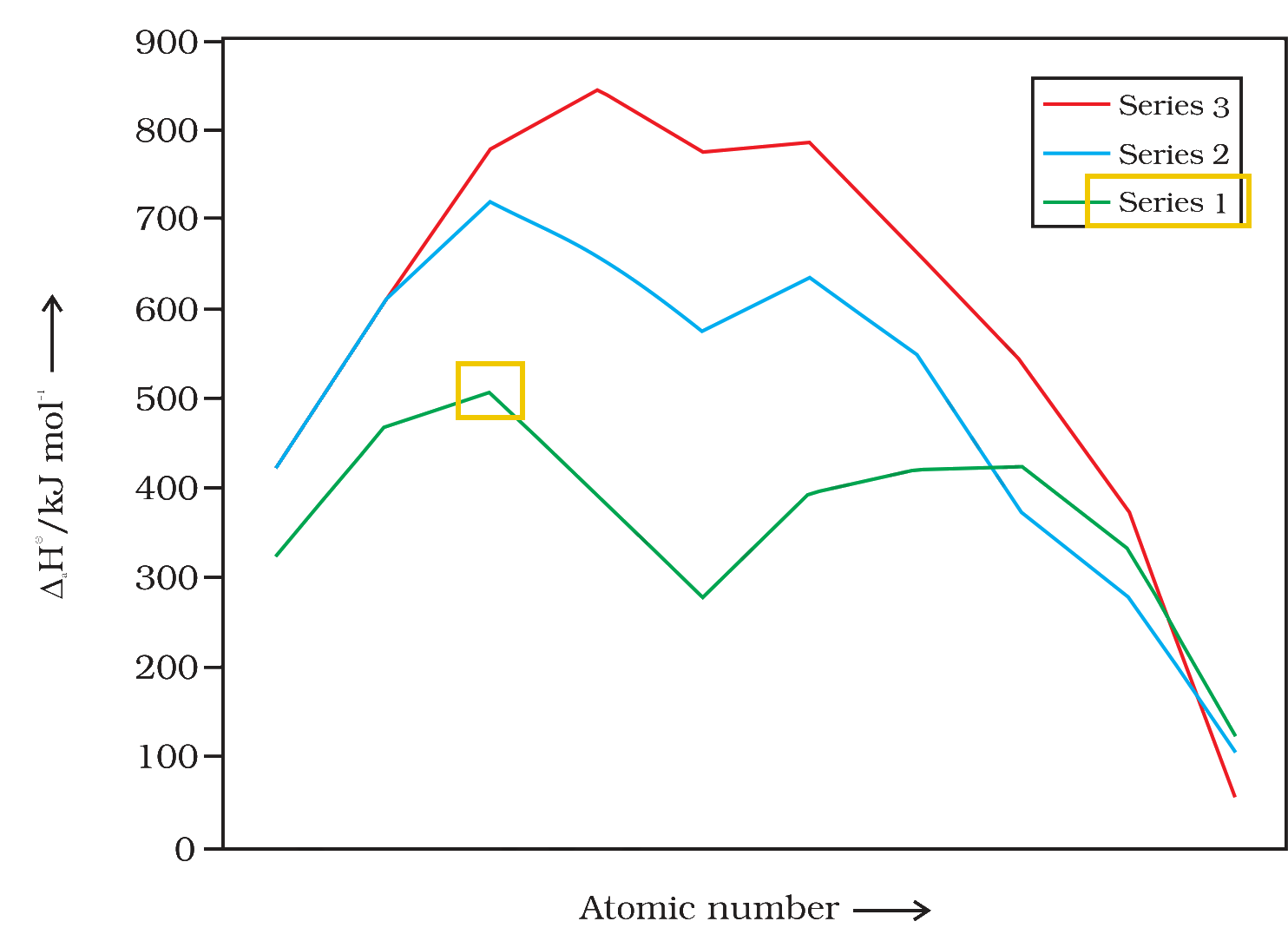
Transition metals have high enthalpies of atomisation because, besides the ns electrons, the unpaired (n−1)d electrons take part in metallic bonding. The values rise to a maximum near the middle of the series, where there is about one unpaired electron per d orbital. Among the options, vanadium (3d34s2, 515 kJ mol−1) has the largest value; titanium (473) has one unpaired d electron fewer, manganese (281) is anomalously low because of its stable half-filled d5 set, and zinc (126) has no unpaired d electrons.
NCERT (2026-27 edition):
Physical Properties – “… The high melting points of these metals are attributed to the involvement of greater number of electrons from (n-1)d in addition to the ns electrons in the interatomic metallic bonding. In any row the melting points of these metals rise to a maximum at d5 except for anomalous values of Mn and Tc and fall regularly as the atomic number increases. They have high enthalpies of atomisation which are shown in Fig. 4.2. The maxima at about the middle of each series indicate that one unpaired electron per d orbital is particularly favourable for strong interatomic interaction.”