
A manufacturing company makes two types of teaching aids A and B of Mathematics for class X. Each type of A requires 9 labour hours for fabricating and 1 labour hour for finishing. Each type of B requires 12 labour hours for fabricating and 3 labour hours for finishing. For fabricating and finishing, the maximum labour hours available per week are 180 and 30 respectively. The company makes a profit of ₹80 on each piece of type A and ₹120 on each piece of type B. How many pieces of type A and type B should be manufactured per week to get a maximum profit? Make it as an LPP and solve graphically. What is the maximum profit per week?
Answer & explanation
Correct answer: option 1
The correct answer is Option (1) → 12 pieces of type A and 6 pieces of type B, with a maximum profit of ₹1680.
Let x and y be the number of teaching aids of type A and type B respectively.
As the profit on the type A of teaching aid is ₹80 and on the type B is ₹120, so the total profit $Z = 80x + 120y$.
Hence, the problem can be formulated as an L.P.P. as follows:
Maximise $Z = 80x + 120y$ Subject to the constraints
$9x + 12y≤ 180$ i.e. $3x + 4y ≤ 60$ (Fabricating constraint)
$x + 3y ≤ 30$ (Finishing constraint)
$x ≥0, y ≥0$ (Non-negative constraints)
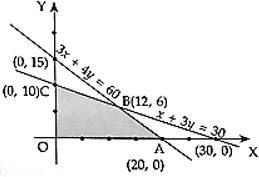
We draw straight lines $3x + 4y = 60, x + 3y = 30$ and shade the region satisfied by the above inequalities.
The shaded region shows the feasible region which is bounded. The point of intersection of the lines $3x + 4y = 60$ and $x + 3y = 30$ is $B(12, 6)$.
The corner points of the feasible region OABC are O(0, 0), A(20, 0), B(12, 6) and C(0, 10). The optimal solution occurs at one of the corner points.
At $O(0, 0), Z = 80 × 0 + 120 × 0 = 0$
At $A (20, 0), Z = 80 × 20 + 120 × 0 = 1600$
At $B(12, 6), Z = 80 × 12 + 120 × 6 = 1680$
At $C(0, 10), Z = 80 × 0 + 120 × 10 = 1200$.
We find that value of Z is maximum at B(12, 6).
Hence, the manufacturer should produce 12 aids of type A and 6 aids of type B to get a maximum profit of ₹1680.