
Nucleophiles, such as ammonia and its derivatives \(H_2N-Z\) add to the carbonyl group of aldehydes and ketones. The reaction is reversible and catalyzed by acid. The equilibrium favours the product formation due to rapid dehydration of the intermediate to form \(-C=N-Z\), where, \(Z =\) Alkyl, aryl, \(OH\), \(NH_2\), \(C_6H_5NH\), \(NHCONH_2\), etc.
What happens when Acetaldehyde reacts with methyl amine?
Answer & explanation
Correct answer: option 1
The correct answer is option 1. Acetaldimine.
When acetaldehyde reacts with methylamine, the product formed is acetaldimine. The carbonyl group \((C=O)\) of acetaldehyde reacts with the amine group \((NH_2)\) of methylamine. This reaction typically involves the nucleophilic attack of the amine nitrogen on the carbonyl carbon, followed by the elimination of water (condensation reaction), forming a Schiff base (imine).
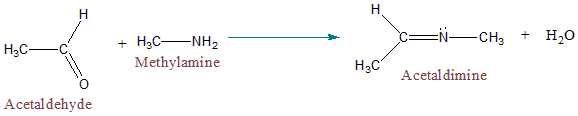
The product of this reaction is acetaldimine, which is also known as N-methylidenemethylamine. When acetaldehyde reacts with methylamine, the product formed is acetaldimine.