Identify the formula for computing break-even-point.
Answer & explanation
Correct answer: option 1
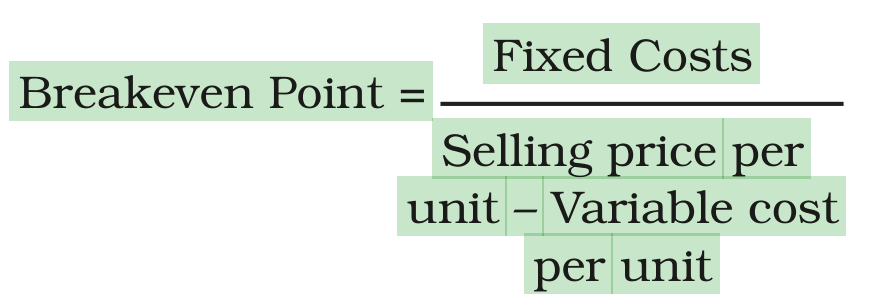
The correct answer is Option (1) → BEP = FC (Fixed Cost) ÷ (Selling Price − Variable Cost per Unit)
The breakeven point is the sales volume at which there is no profit and no loss. Each unit sold gives the selling price minus the variable cost per unit. This amount (called contribution per unit) goes to cover the fixed cost. So the number of units needed to cover the whole fixed cost is the fixed cost divided by this amount.
Option (1) BEP = FC (Fixed Cost) ÷ (Selling Price − Variable Cost per Unit) — Correct. This is the formula: Breakeven Point = Fixed Costs ÷ (Selling price per unit − Variable cost per unit).
Option (2) BEP = SP ÷ (FC − VC) — Incorrect. The fixed cost must be on top, divided by the contribution per unit. Here the terms are mixed up.
Option (3) BEP = VC ÷ (FC − SP) — Incorrect. Here variable cost is divided by fixed cost minus selling price. The breakeven formula puts the fixed cost on top, so the terms are in the wrong places. The terms are again in the wrong places.
Option (4) BEP = (FC − VC) ÷ SP — Incorrect. Fixed cost minus variable cost has no meaning in the breakeven formula.
Note: The current NCERT book (2026-27) only names breakeven analysis as a technique of control. The breakeven point and its formula are explained in the pre-rationalised NCERT, from which the extract below is taken. NCERT (Pre-rationalised Edition): “Breakeven Analysis Breakeven analysis is a technique used by managers to study the relationship between costs, volume and profits. It determines the probable profit and losses at different levels of activity. The sales volume at which there is no profit, no loss is known as breakeven point. …” “Breakeven point can be calculated with the help of the following formula:”
|