
The standard potential of the cell \( (E_{cell}^θ) \) is related to the equilibrium constant (\( K_C \)) as
Answer & explanation
Correct answer: option 4
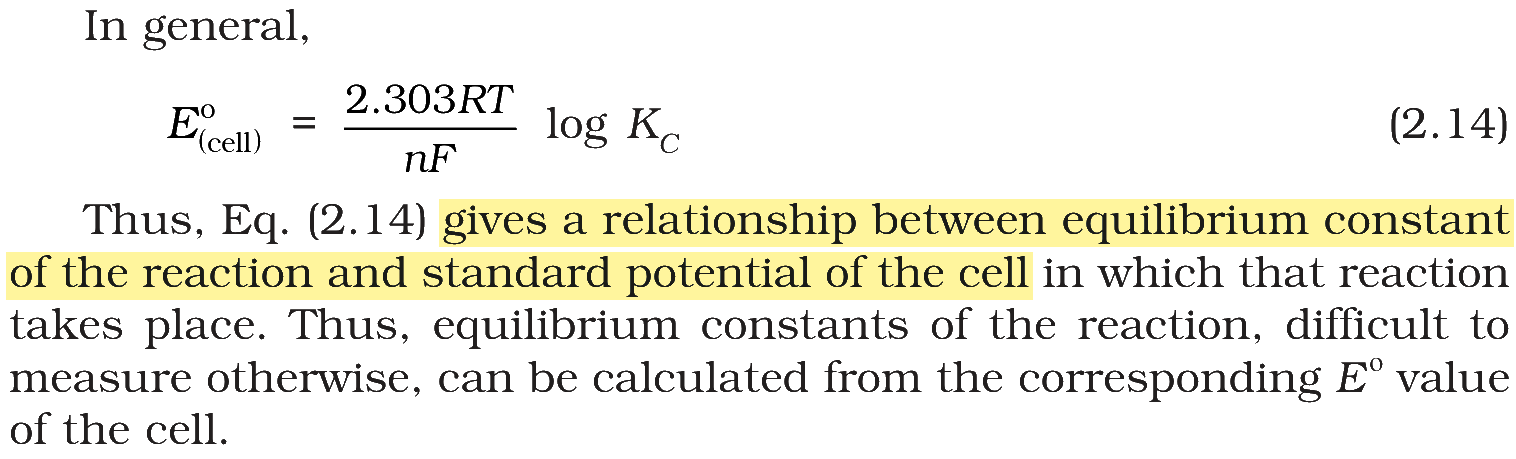
The correct answer is Option (4) → \(E_{cell}^\theta=\frac{2.303\,RT}{nF}\log K_C\)
The relation comes from two expressions for the standard Gibbs energy of the cell reaction. Electrical work gives \( \Delta_r G^{\circ} = -nFE^{\circ}_{\text{cell}} \), and thermodynamics gives \( \Delta_r G^{\circ} = -RT\ln K_C \). Equating the two:
\( \displaystyle -nFE^{\circ}_{\text{cell}} = -RT\ln K_C \)
\( \displaystyle E^{\circ}_{\text{cell}} = \frac{RT}{nF}\ln K_C \)
\( \displaystyle E^{\circ}_{\text{cell}} = \frac{2.303\,RT}{nF}\log K_C \)
The same result follows from the Nernst equation: at equilibrium \( E_{\text{cell}} = 0 \) and the reaction quotient equals \( K_C \). At 298 K, \( 2.303RT/F = 0.059 \) V, so \( E^{\circ}_{\text{cell}} = \frac{0.059}{n}\log K_C \).
Shortcut: \( RT/F \) has the unit of volts (J mol−1 divided by C mol−1), so the right side must contain \( RT/nF \), not its inverse, and \( K_C \) must appear inside a log. Only Option (4) satisfies both.
Why the other options are incorrect
Option (1) \(E_{cell}^\theta=\frac{2.303\,nRT}{F}\log K_C\) — Incorrect. n belongs in the denominator, since \( \Delta_r G^{\circ} = -nFE^{\circ} \) is divided by nF.
Option (2) \(E_{cell}^\theta=\frac{2.303\,nF}{RT}\log K_C\) — Incorrect. The fraction is inverted; \( nF/RT \) has the unit V−1, not V.
Option (3) \(E_{cell}^\theta=\frac{2.303\,RT}{nF}\times K_C\) — Incorrect. The potential depends on the logarithm of \( K_C \), because \( \Delta G^{\circ} = -RT\ln K \).
NCERT (2026-27 edition):
Nernst Equation – …
Note: The same/similar question has been asked in different years by NTA as per the details given below:
| 2026 | 2025 | 2024 | 2023 | 2022 |
|---|---|---|---|---|
| – | 30-05 S1 21-05 S1 | – | – | – |