Match List-I with List-II
| List-I | List-II |
| (A) Marginal Propensity to Consume | (I) C/Y |
| (B) Marginal Propensity to Save | (II) ΔC/ ΔY |
| (C) Average Propensity to Save | (III) S/Y |
| (D) Average Propensity to Consume | (IV) ΔS/ΔY |
Choose the correct answer from the options given below:
Answer & explanation
Correct answer: option 3
The correct answer is Option (3) → (A)-(II), (B)-(IV), (C)-(III), (D)-(I)
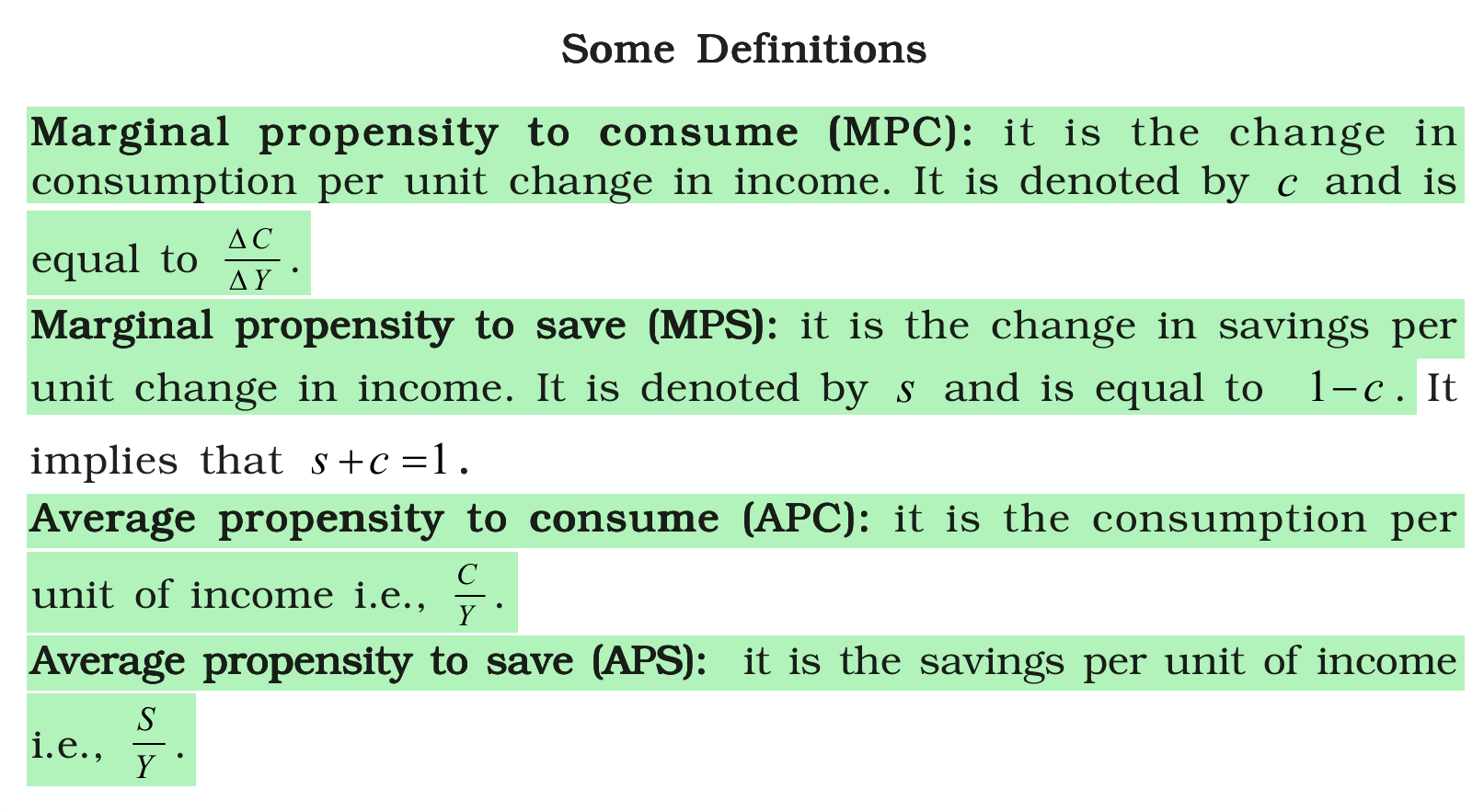
A propensity tells how much of income is consumed or saved. An average propensity divides the total by income. A marginal propensity divides the change by the change in income.
| List-I | List-II | Reason |
|---|---|---|
| (A) Marginal Propensity to Consume | (II) ΔC/ ΔY | The change in consumption per unit change in income. |
| (B) Marginal Propensity to Save | (IV) ΔS/ΔY | The change in saving per unit change in income. It equals 1 − Marginal Propensity to Consume. |
| (C) Average Propensity to Save | (III) S/Y | Saving per unit of income. |
| (D) Average Propensity to Consume | (I) C/Y | Consumption per unit of income. |
Note: A same/similar question was asked in CUET (UG) in the papers below.
| 2026 | 2025 | 2024 | 2023 | 2022 |
| 11-05 S2* | 13-05 S2* 14-05 S1* 28-05 S1* 02-06 S1 | – | – | 16-07 S1* |
* A similar question.
NCERT (2026-27): Introductory Macroeconomics — Chapter 4: Determination of Income and Employment
|