C-Cl bond in chlorobenzene in comparison to C-Cl bond in methyl chloride is:
Answer & explanation
Correct answer: option 3
The correct answer is Option (3) → Shorter and strong.
Two effects make the C–Cl bond of chlorobenzene shorter and stronger than that of methyl chloride:
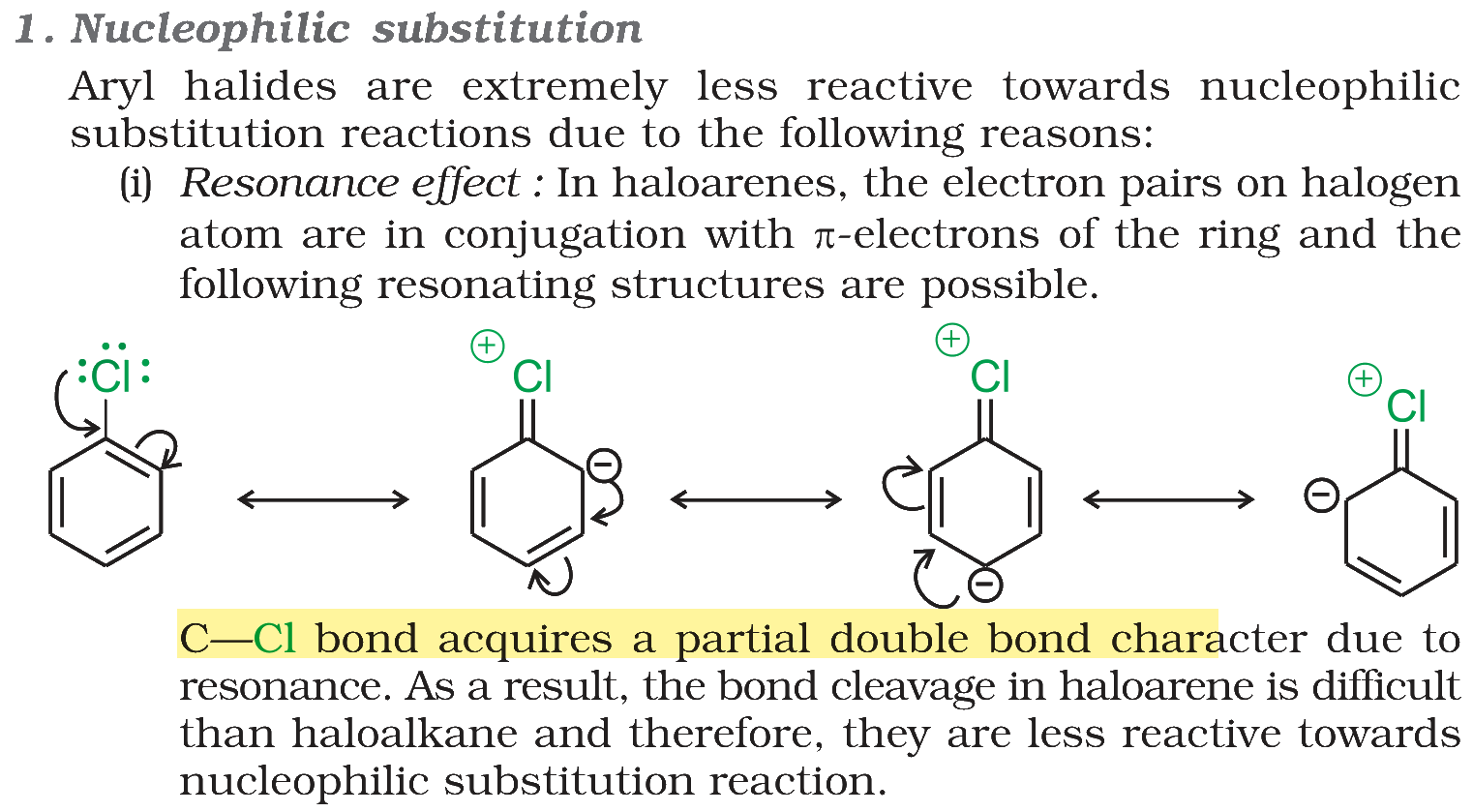
Resonance: a lone pair on Cl is in conjugation with the π-electrons of the ring, so the C–Cl bond acquires partial double bond character.
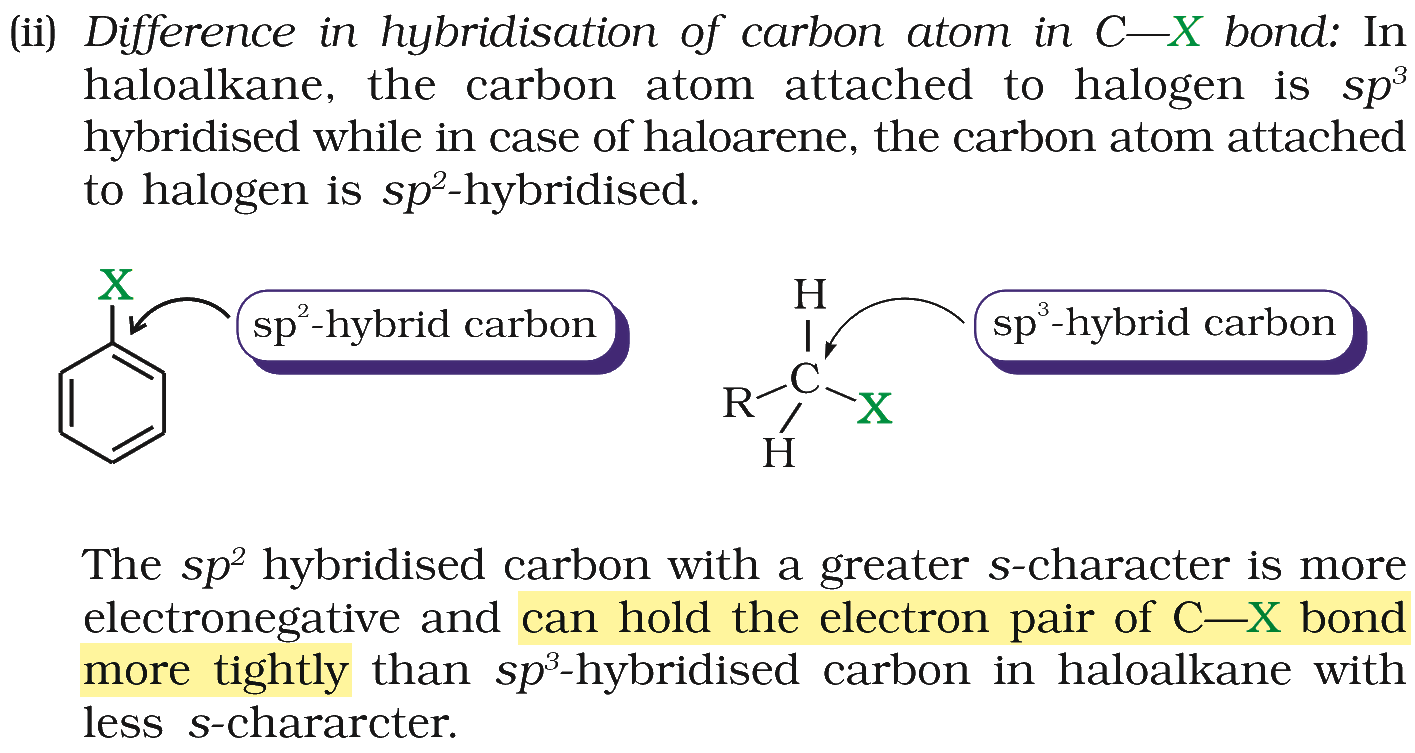
Hybridisation: in chlorobenzene Cl is bonded to an sp2 carbon, in methyl chloride to an sp3 carbon. The sp2 carbon has more s-character, is more electronegative and holds the bonding pair more tightly.
The C–Cl bond length is 169 pm in chlorobenzene against 177 pm in methyl chloride. This is why haloarenes are much less reactive towards nucleophilic substitution.
Why the other options are incorrect
Option (1) Longer and weaker. — Incorrect. Both effects shorten the bond and make it stronger, not weaker.
Option (2) Shorter and weaker. — Incorrect. A bond with partial double bond character is both shorter and stronger; “shorter and weaker” contradicts itself here.
Option (4) Longer and strong. — Incorrect. The bond is shorter (169 pm against 177 pm), not longer.
NCERT (2026-27 edition):
Nucleophilic Substitution
Nucleophilic Substitution – …