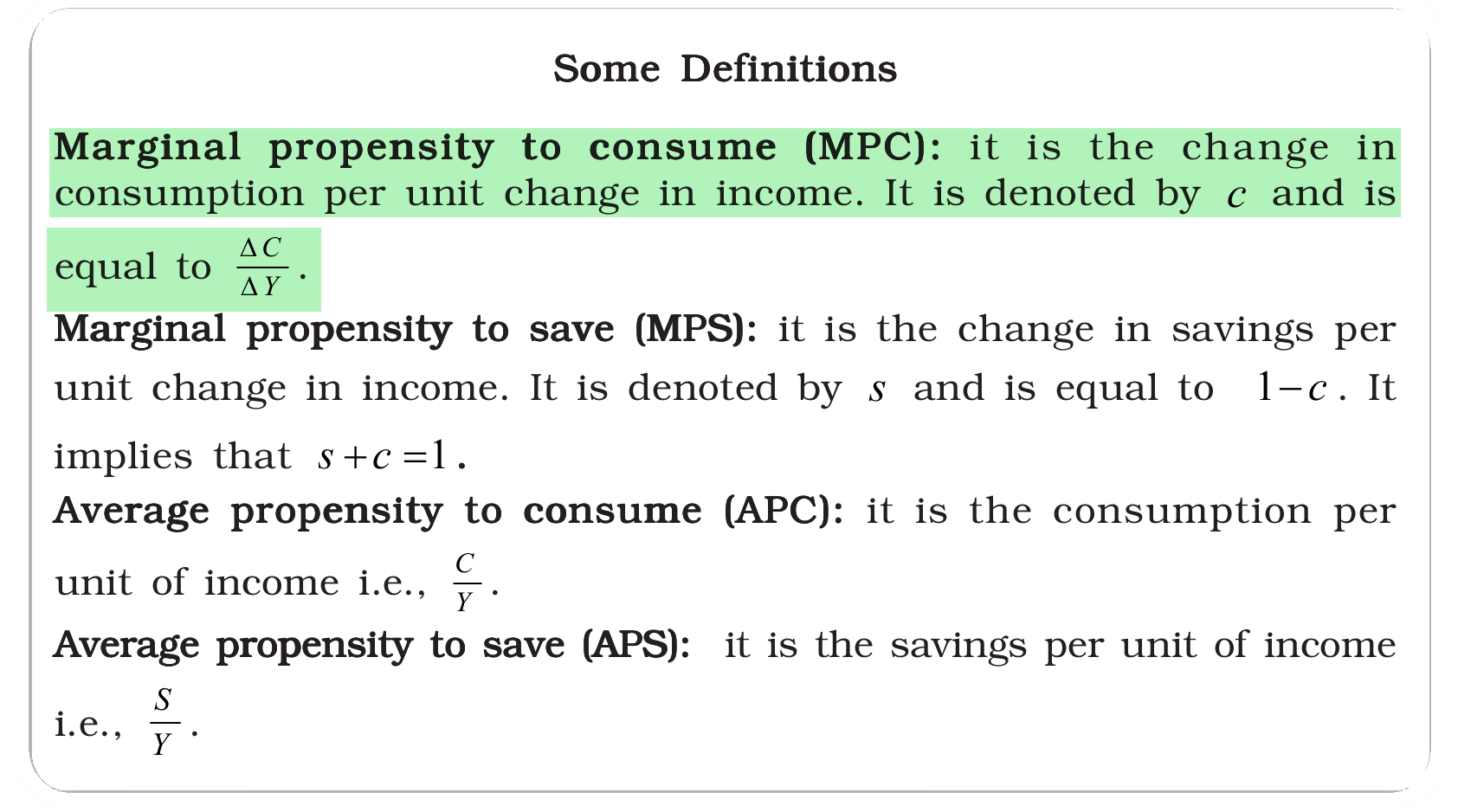
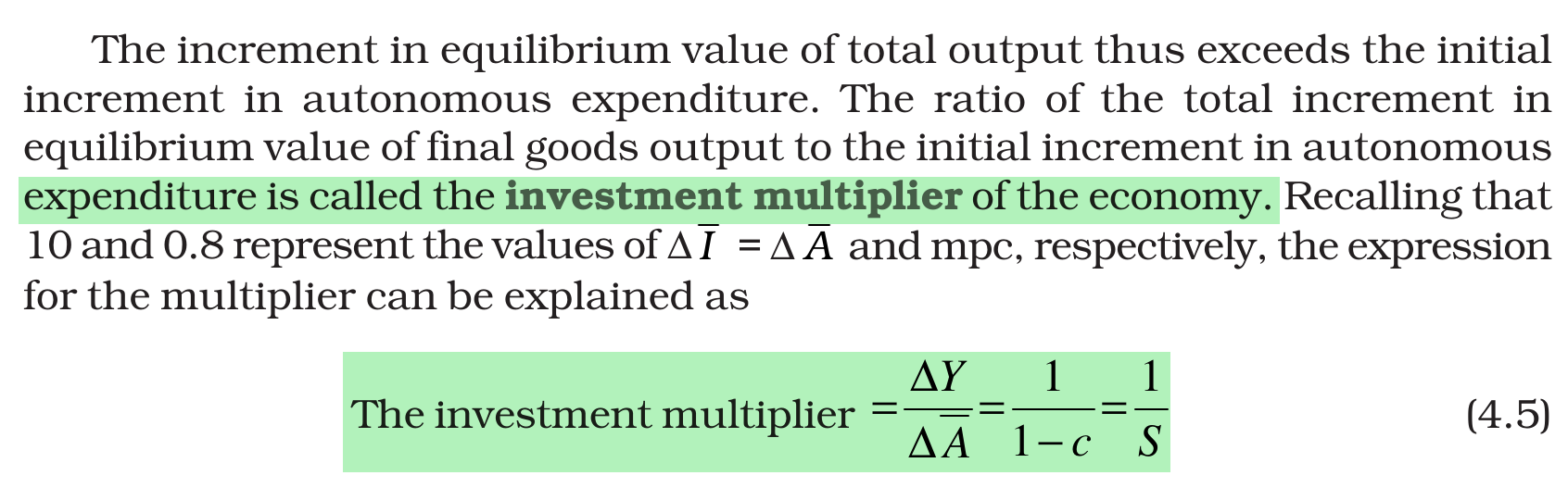
If \( k=\frac{1}{1-c} \) and
K = Investment Multiplier, then c is
Answer & explanation
Correct answer: option 2
The correct answer is Option (2) → Marginal Propensity to Consume
The investment multiplier (k) tells how many times income rises when investment rises by one rupee. It depends on how much of each extra rupee of income people spend. That share is the marginal propensity to consume (MPC), written c: the change in consumption per unit change in income.
Option (1) Consumption — Incorrect. Consumption is the total amount spent, written with a capital C. The multiplier uses the small c, the share of extra income spent.
Option (2) Marginal Propensity to Consume — Correct. A larger c means more of each extra rupee is spent again, so k is larger. For example, c = 0.8 gives k = 1/(1 − 0.8) = 5.
Option (3) Marginal Propensity to income — Incorrect. There is no such term. A propensity is measured out of income, to consume or to save.
Option (4) Saving — Incorrect. Saving is the part of income not consumed. In the formula, 1 − c is the marginal propensity to save (MPS). So the multiplier can also be written k = 1/MPS.
NCERT (2026-27): “4.1.1. Consumption …If consumption takes place even when income is zero, it is because of autonomous consumption. The induced component of consumption, cY shows the dependence of consumption on income. When income rises by Re 1. induced consumption rises by MPC i.e. c or the marginal propensity to consume. It may be explained as a rate of change of consumption as income changes.…”
|