
CUETMOCK
  • Pricing
  • Mentors
Log inStart freeStart free mocks→

First test, then trust

Try a free CUET mock test.

Join 5,00,000+ students who rehearsed exam day on the exact NTA screen before sitting CUET. On the web and on Android.

Start free mocks →Get the Android app
CUETMOCK

India's #1 CUET Mock Test Platform. Original NCERT-based questions on the exact NTA exam screen — trusted by 5,00,000+ students since CUET 2022.

Get it onGoogle PlayScan to download the CUETMOCK app

Mock tests

  • CUET mock test series
  • Browse all papers
  • Commerce mocks
  • Humanities (Arts) mocks
  • Science mocks
  • Languages & GAT mocks
  • Free practice questions
  • Pricing

Resources

  • CUET exam guide
  • CUET syllabus
  • Universities accepting CUET
  • Expert blogs
  • News & notifications
  • Webinars & counselling
  • CUET score calculator
  • How we estimate your rank
  • FAQs

Company

  • About us
  • Our leadership & team
  • Our toppers
  • Mentors
  • For schools
  • Contact us
  • Terms
  • Privacy
  • Refund policy

Talk to us

+91 7696 6630 56info@cuetmock.comWhatsApp us

Our other platforms

  • JEE Mock — For IIT-JEE aspirants
  • NEET Mock — For NEET aspirants

Newsletter

Exam updates, study material and offers — no spam.

© 2026 NYC Ventures Pvt. Ltd.

701-702, Royal Business Park, Zirakpur, Punjab - 140603

  • Terms of use
  • Privacy policy
  • Refund policy
  • Contact us

iCUETMOCK is an independent preparation platform, not affiliated with the National Testing Agency (NTA). Always check exam details on the official NTA website.

  • Home
  • Mock tests
  • CUET guide
  • Pricing
  • Log in
Home/Practice questions/Chemistry
ChemistryOrganic: Haloalkanes and Haloarenes

Which of the following compound reacts with chlorobenzene to produce…

Which of the following compound reacts with chlorobenzene to produce DDT?

Answer & explanation+

Correct answer: option 1

The correct answer is option 1. trichloroacetaldehyde.

DDT is produced by the reaction of chlorobenzene with chloral (trichloroacetaldehyde) in the presence of concentrated sulfuric acid. The reaction is shown below:
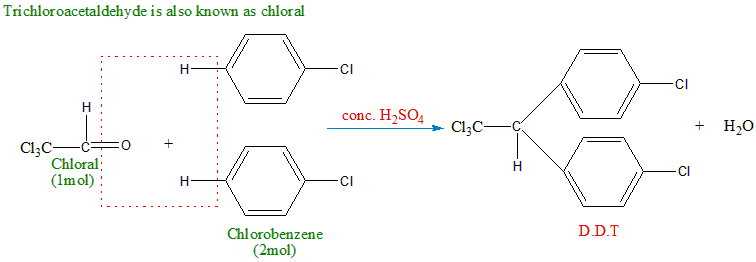
The other options are incorrect. Option (2) m-chloroacetaldehyde, is not a trichloroacetaldehyde and will not react with chlorobenzene to produce DDT. Option (3) acetaldehyde, is not a trichloroacetaldehyde and will not react with chlorobenzene to produce DDT. Option (4) nitrobenzene, is not a halogenated compound and will not react with chlorobenzene to produce DDT.

Advertisement

Practise more on Organic: Haloalkanes and Haloarenes

Chapter-wise mocks on the real NTA exam screen, with solutions and your rank. Your first mocks are free.

Start free mocks →

Advertisement

Next questions

  1. Select the most appropriate option to fill in the blank. The crowing witch released a ______ cackle as she turned the boy into a beast.English · Fill Blanks
  2. Ustad Amjad Ali Khan Bangash is an Indian classical _________ player.General Aptitude Test · General Knowledge
  3. A first-order reaction requires 6.96 months for the concentration of reactant A to be reduced to 25% of its original value. The half-life o…Chemistry · Physical: Chemical Kinetics
  4. The ratio of money held by the public in currency to that held as deposits in commercial banks is called :Economics · Macro Economics: Money and Banking
  5. A speech signal of 3 kHz is used to modulate a crrier signal of frequency ! MHz, using amplitude modulation. What will be the frequencies o…Physics · Communication
  6. Who among the following had been given the title of ‘Sultan Buland Iqbal’ by Shah Jahan?General Aptitude Test · General Knowledge
  7. Which of the following rivers flow into the Arabian Sea?General Aptitude Test · General Knowledge
  8. The permanent magnetic moment of the atoms of a material is zero. What can you say about the material ?Physics · Magnetism and Matter
  9. Which of the following port is only concerned with the transportation of passengers and mail across water bodies covering short distances?Geography · Fundamentals of Human Geography: International Trade
  10. Which of the following statements is correct?Economics · Macro Economics: Open Economy Macro Economics