Read the passage carefully and give the answers to the next five questions:
Does the number of species in a community really matter to the functioning of the ecosystem? This is a question for which ecologists have not been able to give a definitive answer. For many decades, ecologists believed that communities with more species, generally, tend to be more stable than those with less species. According to the International Union for Conservation of Nature and Natural Resources (IUCN) (2004), the total number of plant and animal species described so far is more than 1.5 million.
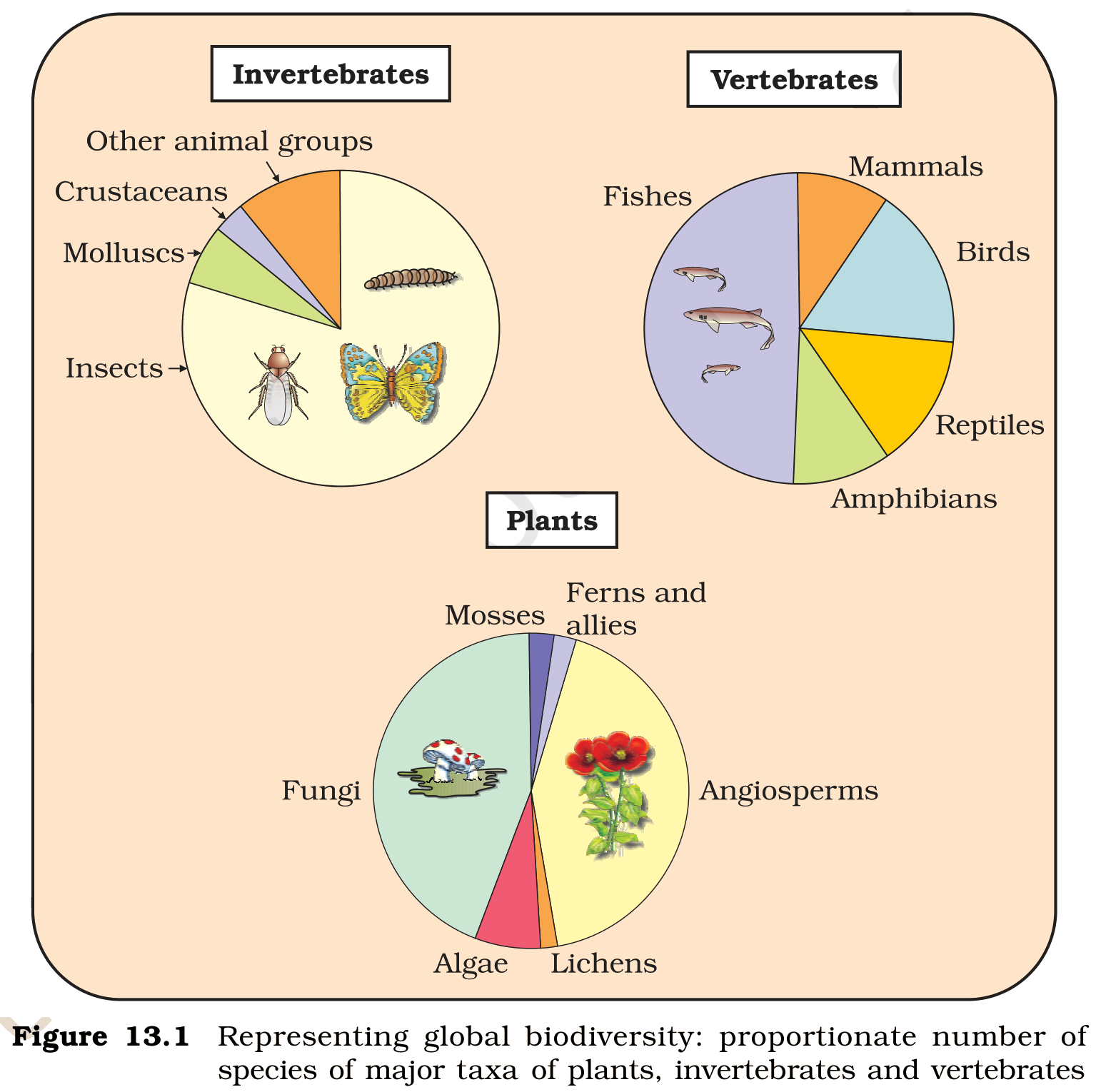
Among the vertebrates, which of the following is the most species-rich group?
Answer & explanation
Correct answer: option 2
The correct answer is Option (2) → Fishes
Option (2) Fishes — Correct. Fishes make up about half of all vertebrate species, more than birds, reptiles, amphibians and mammals, as the vertebrate chart of Figure 13.1 shows. Insects are the most species-rich group of animals, but they are invertebrates, so they are not counted among the vertebrates.
Note: The passage is taken from NCERT. NTA has put lines of the NCERT text together to make it. Most CUET (UG) questions come straight from NCERT, so study the book line by line, including figures and their titles.
NCERT Extract:
How Many Species Are There on Earth and How Many in India? – “… Let us look at some interesting aspects about earth’s biodiversity based on the currently available species inventories. More than 70 per cent of all the species recorded are animals, while plants (including algae, fungi, bryophytes, gymnosperms and angiosperms) comprise no more than 22 per cent of the total. Among animals, insects are the most species-rich taxonomic group, making up more than 70 per cent of the total. That means, out of every 10 animals on this planet, 7 are insects. … The number of fungi species in the world is more than the combined total of the species of fishes, amphibians, reptiles and mammals. In Figure 13.1, biodiversity is depicted showing species number of major taxa.”