On what basis scandium is a considered as transition metal, but Zinc is not considered as transition metal?
Answer & explanation
Correct answer: option 2
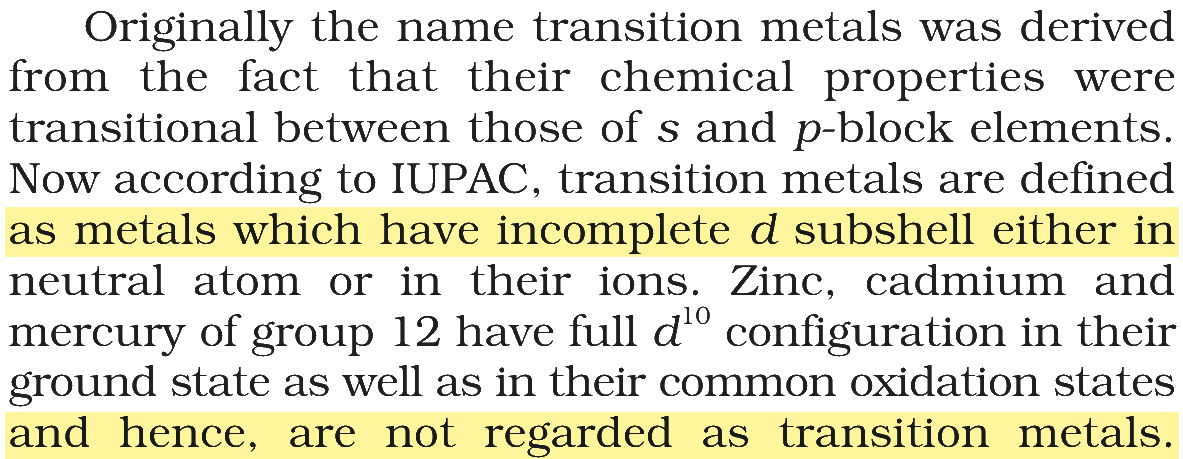
The correct answer is Option (2) → on the basis of an incompletely filled 3d orbital in the case of Scandium atom in its ground state, but Zinc has completely filled 3d orbital in its ground and its oxidation state.
By the IUPAC definition, transition metals have an incomplete d subshell either in the neutral atom or in their ions. Compare the two elements from their atomic numbers:
Sc (Z = 21): \( \mathrm{[Ar]\,3d^{1}\,4s^{2}} \). The atom has one 3d electron, an incomplete 3d subshell, so scandium is a transition metal.
Zn (Z = 30): \( \mathrm{[Ar]\,3d^{10}\,4s^{2}} \). Its only common ion, \( \ce{Zn^2+} \), loses the two 4s electrons and is \( \mathrm{3d^{10}} \). The 3d subshell is completely filled in the atom and in the ion, so zinc is not regarded as a transition metal, though it is placed in the d-block.
Why the other options are incorrect
Option (1) presence of filled s orbital in Scandium and Zinc. — Incorrect. Both have a filled 4s orbital, so this cannot be the difference; the definition depends on the d subshell.
Option (3) Zinc shows d-d transition. — Incorrect. \( \ce{Zn^2+} \) is 3d10 with no vacant d orbital, so no d–d transition is possible; this is why zinc compounds are white.
Option (4) 3d orbital filled prior to 4s in Zinc — Incorrect. By the aufbau principle the 4s orbital fills before 3d, in zinc as in other elements.
NCERT (2026-27 edition):
The d- and f-Block Elements – …